
Create The Edge Academy · Proposal Knowledge and Learning System · 2026 Edition
B
Industry Terminology & Definitions
The professional language that signals authority, prevents misunderstanding, and separates credible consultants from everyone else in the room.
Northstar Design Collaborative · Internal Use Only · 2026
MODULE B · BRIEFINGS
Watch and Listen
Section Briefings
Watch the video, listen to the podcast, then read the module for the detail. The same terminology framework in three formats.
Why every word you choose signals whether you belong in the room.
The full terminology framework, narrated. The same vocabulary in audio form.
Section B · Professional Industry Terminology Guide
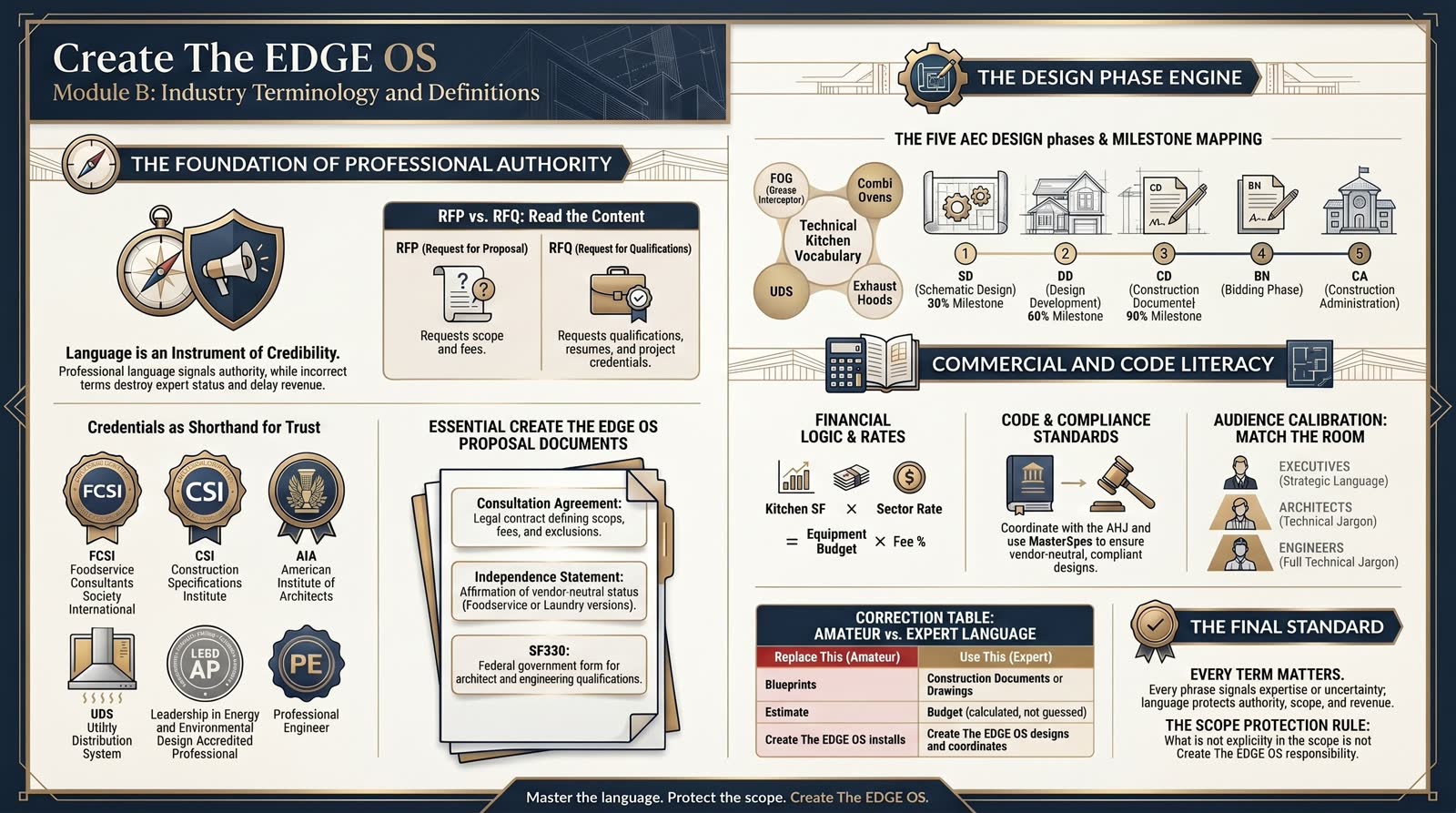
MODULE B · PRESENTATION
Presentation Slides
The Language of Authority · Slide Deck
Twelve slides covering the complete industry terminology framework. Advance through each slide to reinforce the vocabulary before reading the sub-modules.

MODULE B · FOUNDATIONS
B.1 · Why Language Matters
Why Industry Language Matters
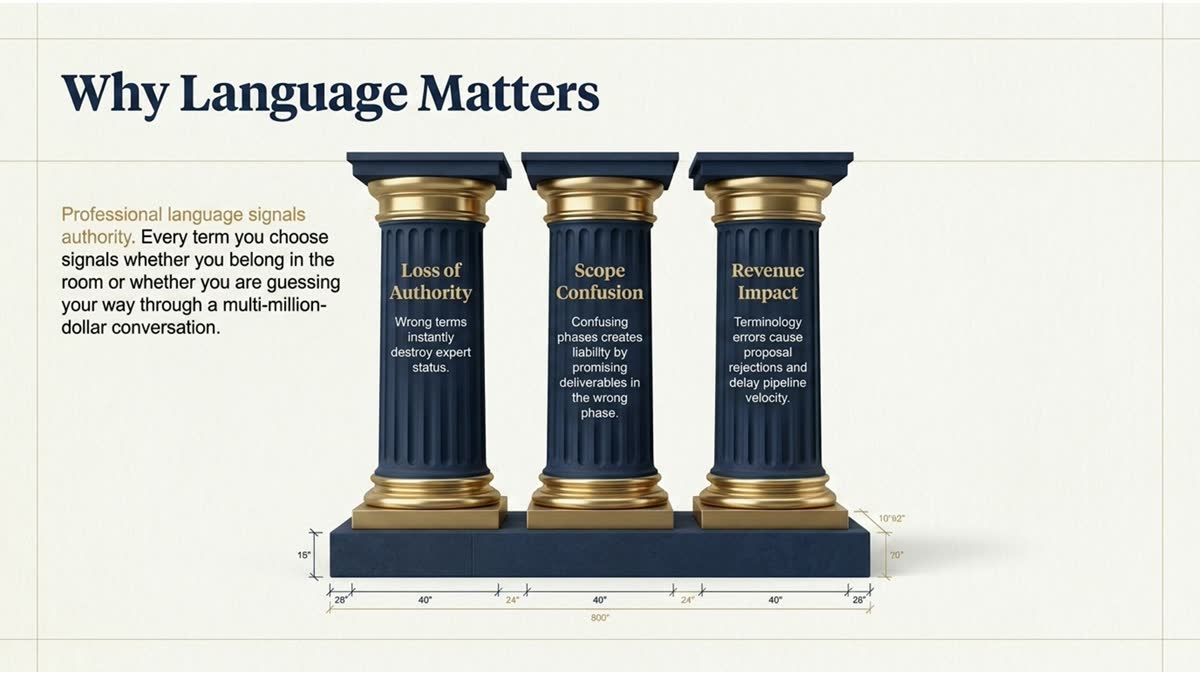
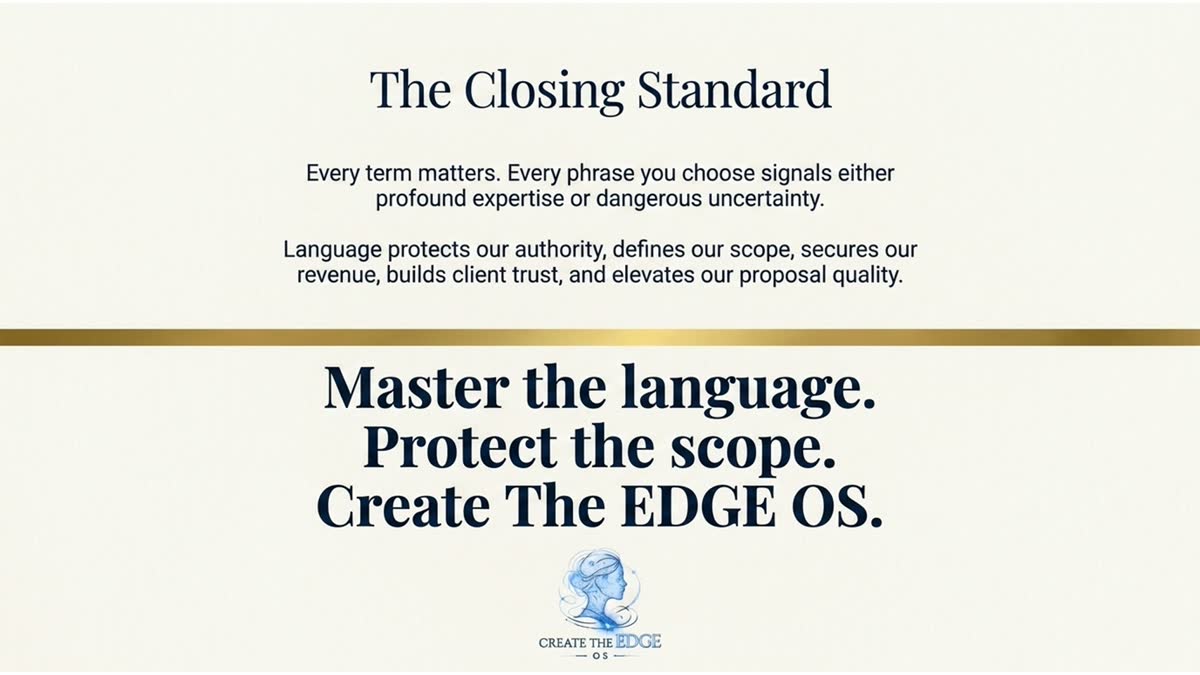
In professional consulting, the words you use are not decoration. They are instruments of credibility. Every term you choose signals whether you belong in the room or whether you are guessing your way through a conversation that costs your client millions of dollars.
At Northstar Design Collaborative, vocabulary is a core professional skill ranked alongside proposal writing, fee calculation, and client communication. The language you use in emails, phone calls, proposals, and presentations determines whether clients perceive you as a trusted authority or a generic vendor reading from a script.
This module establishes the foundational terminology you will encounter daily. Every term defined here appears repeatedly in the [Department Manager] training notes, in client-facing documents, in the review process, and in internal communications. Misusing any of these terms is not a minor mistake: it signals to the client that you do not understand the work you are proposing to do.
❞ Expert Insight
"If you say 'blueprints' instead of 'construction documents,' the architect knows you are not from this world. If you confuse an RFP with an RFQ, the client wonders who trained you. Language is the first filter. Pass it or you never get to show what you actually know."
Create The Edge Academy · The Proposal Standard
Figure B.1 · The Three Consequences of Incorrect Terminology
1
Consequence
Loss of Authority
Wrong terms destroy the expert status Northstar Design Collaborative has spent decades building.
2
Consequence
Scope Confusion
Confusing phases or terms creates liability by promising deliverables in wrong phases.
3
Consequence
Revenue Impact
Proposals with terminology errors get sent back, delaying pipeline velocity and revenue.
Rule
House Standard
Zero Exceptions
There is no context in which "close enough" is acceptable in Northstar Design Collaborative communications.
▦ Rule of the House
Every term in this module must be used correctly in all Northstar Design Collaborative communications: proposals, cover letters, consultation agreements, emails, phone calls, and presentations. There are no exceptions, and there is no context in which "close enough" is acceptable.
MODULE B · TERMINOLOGY
B.2 · Proposal & Document Terms
Proposal & Document Terms
These are the terms you will use most frequently. Every document that leaves Northstar Design Collaborative uses these terms precisely.
Figure B.2 · Proposal & Document Terminology Reference
| Term | Definition | Why It Matters |
|---|---|---|
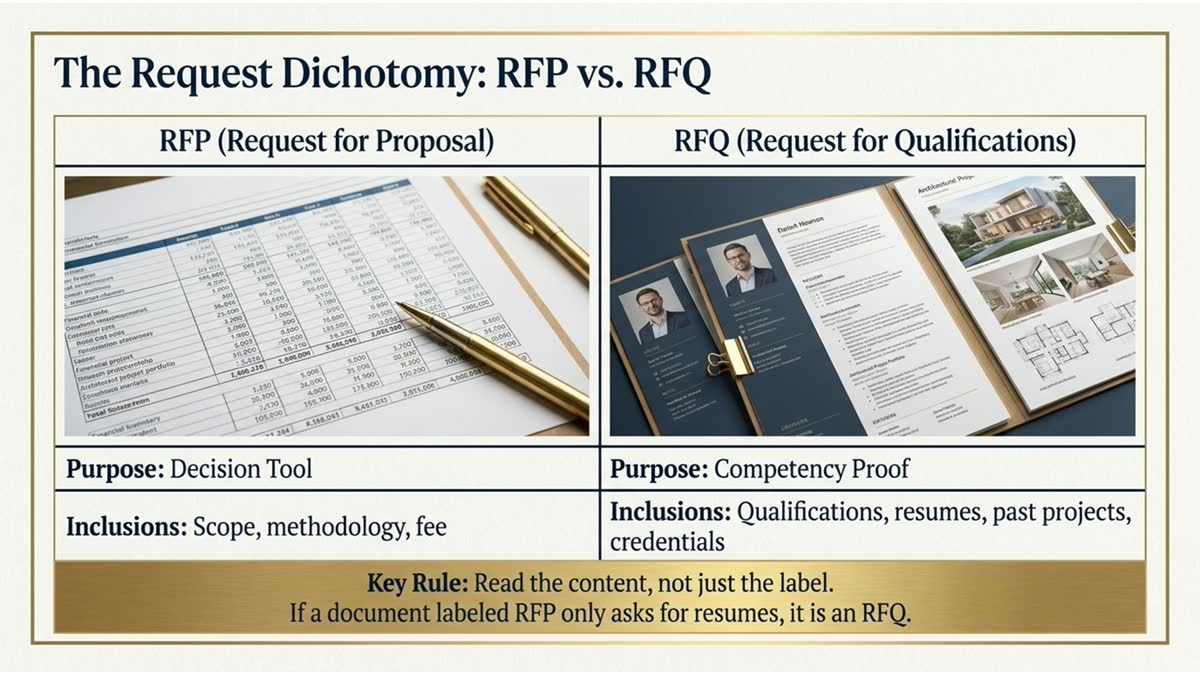
| RFP | Request for Proposal. A formal document requesting a detailed proposal including scope, methodology, and fee. The response is a decision tool. | The majority of Northstar Design Collaborative work originates through RFPs. |
| RFQ | Request for Qualifications. Asks firms to demonstrate competency: resumes, past projects, credentials. No fee is quoted initially. | RFQs take ~4 hours each. Completing one is a competitive advantage since many competitors will not finish. |
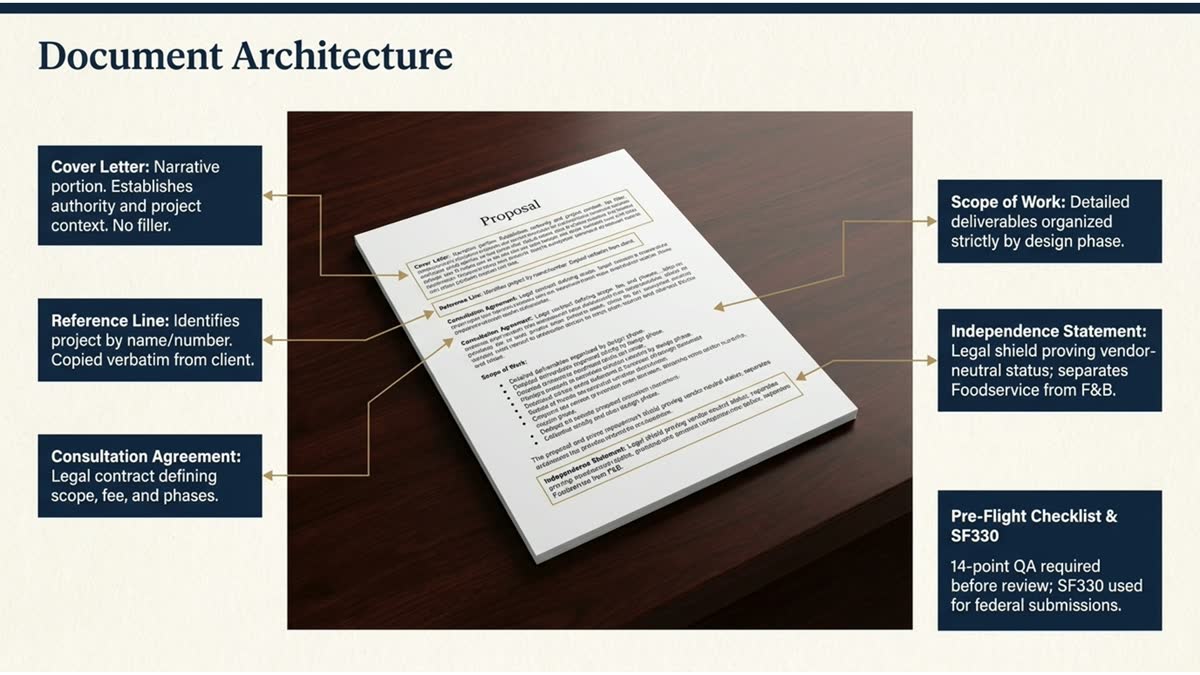
| Consultation Agreement | The legal contract portion of a proposal. Defines scope, fee, phases, payment terms, and exclusions. | Every word has legal weight. Must match the cover letter exactly. |
| Cover Letter | The narrative portion of a proposal. Introduces project context, establishes authority, describes approach, and summarizes scope. | The first two paragraphs carry the most weight. No filler, no "we are pleased to present." |
| Reference Line | The line at the top of the proposal identifying the project by name, client, and project number. Copied verbatim from the client's RFP. | Must be identical each time it appears. Inconsistency signals carelessness. |
| SF330 | Standard Form 330. A federal government form for architect and engineering qualifications submissions. | Narrative sections can be populated from existing proposals. |
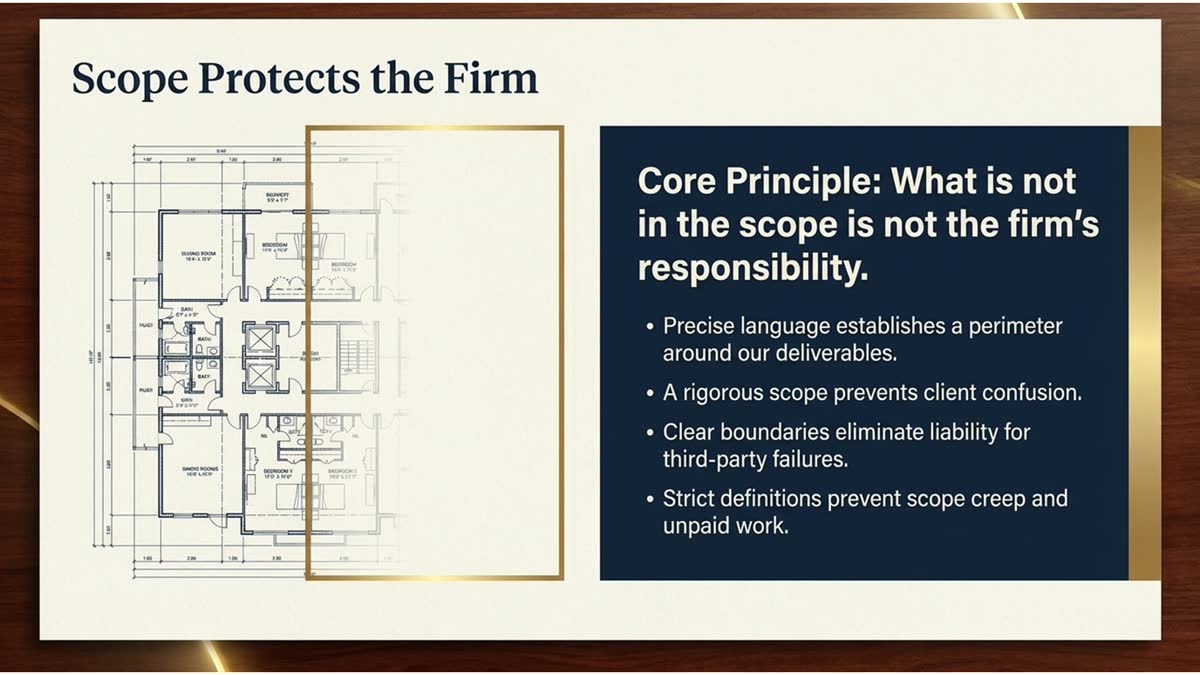
| Scope of Work | Detailed description of all deliverables organized by design phase (SD, DD, CD, BN, CA). | What is not in the scope is not Northstar Design Collaborative's responsibility. Precision protects the firm. |
| Independence Statement | Required paragraph affirming vendor-neutral status. Confirm the correct version for your engagement context. | Not optional. Wrong version signals the reviewer you did not read the RFP. |
| Pre-Flight Checklist | 14-point quality assurance checklist applied before the review process. | No proposal moves to [Department Manager] without completing it. |
⚠ Watch Out
RFP and RFQ are not interchangeable. Calling an RFQ an RFP in your response signals that you did not read the request. Architects sometimes mislabel documents. Your job is to read the content and respond to what is actually being asked, regardless of the label.
MODULE B · TERMINOLOGY
B.3 · Design Phase Terminology
Design Phase Terminology
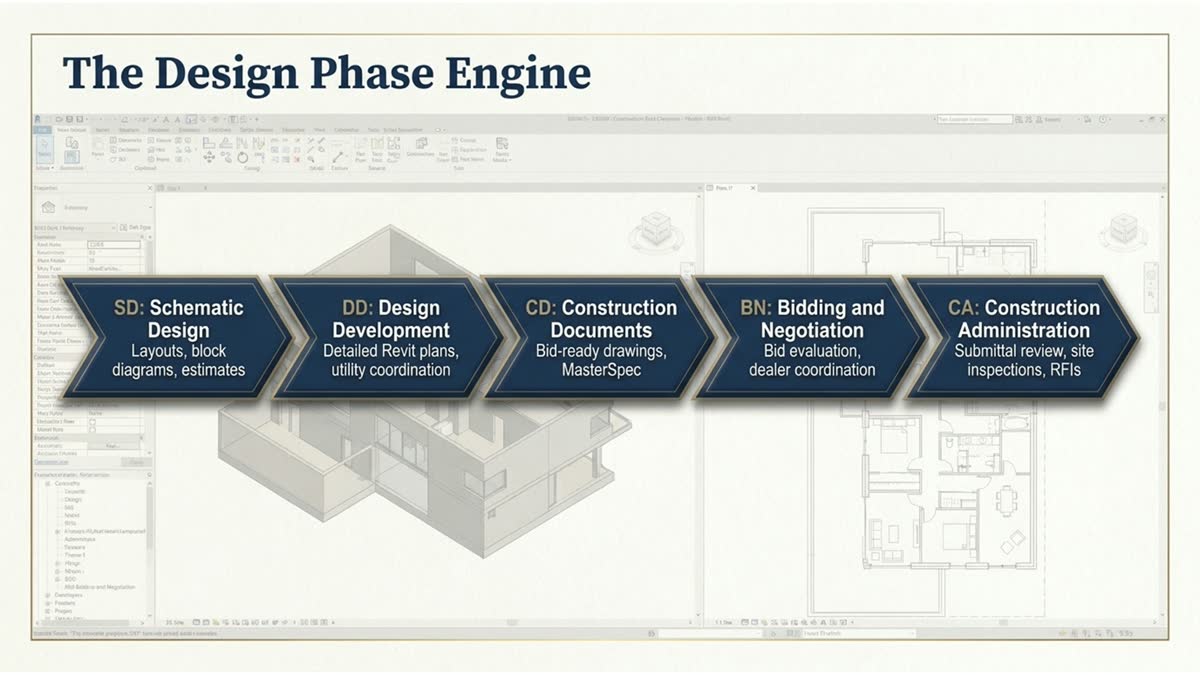
Every Northstar Design Collaborative proposal is structured around the standard AEC design phases. These phases define the workflow, determine the fee, and establish deliverables. Know these cold.
Figure B.4 · The Five Standard AEC Design Phases
SD
Conceptual Design
Layouts, block diagrams, order-of-magnitude estimates.
DD
Design Development
Detailed Revit plans, data books, utility coordination.
CD
Construction Docs
Bid-ready drawings, MasterSpec, connection plans.
BN
Bidding / Negotiation
Bid evaluation, dealer coordination, addenda.
CA
Construction Admin
Submittal review, RFIs, site inspections, punch list.
Figure B.5 · Additional Design Phase Terms
| Term | Definition | Context |
|---|---|---|
| Programming / Conceptual | Optional early phase: establishing goals, confirming menus, creating block diagrams before design begins. | Complex new construction for large institutions. |
| Equipment Survey | Optional phase for renovations: inventorying existing equipment, evaluating condition, identifying non-compliance. | Renovation projects only. New construction skips this. |
| Waterfall Structure | Each phase must be completed and approved before the next begins. Client signs off at each gate. | Most Northstar Design Collaborative proposals use waterfall. "Upon written approval of [phase]..." |
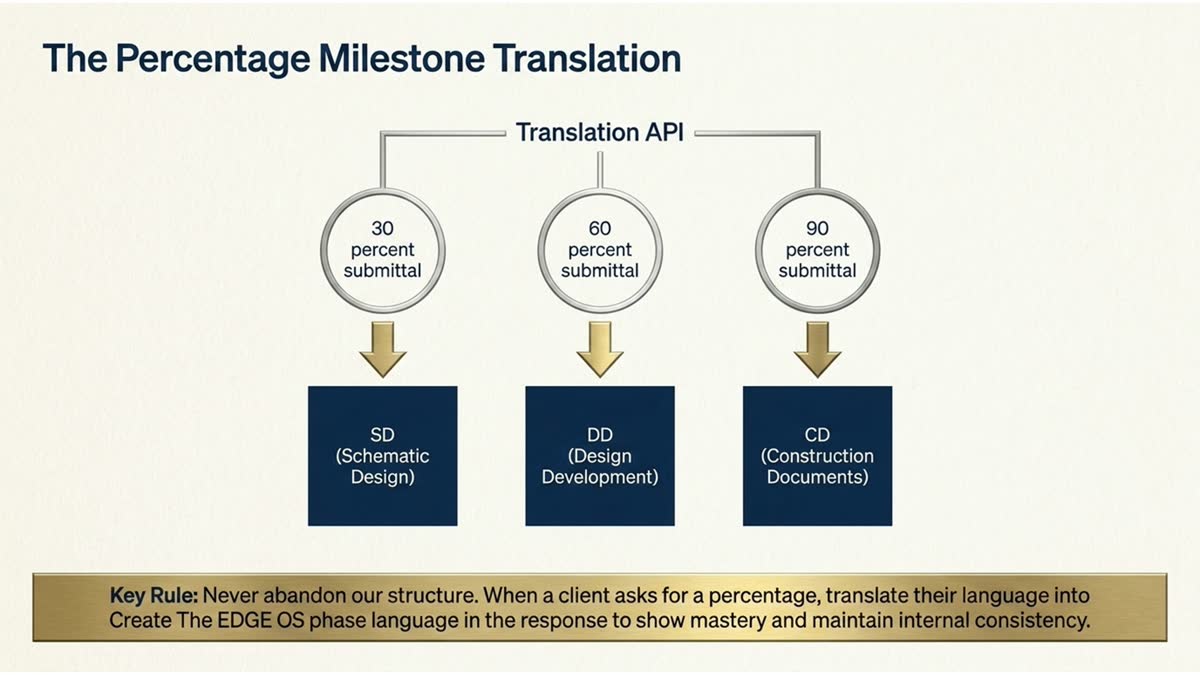
| 30% / 60% / 90% | Percentage milestones mapping to phases: SD = 30%, DD = 60%, CD = 90%. Government clients use this. | Map their percentage language to your phase abbreviations in the proposal. |
| BIM / Clash Detection | Building Information Modeling: 3D digital models for design coordination. Clash Detection finds conflicts before construction. | Northstar Design Collaborative uses BIM (Revit) to coordinate with architectural and MEP systems. |
✓ Best Practice
When an RFP uses different phase names, map their language to yours: "Phase I: Conceptual Design (referred to in the RFP as '30% Design Submittal')." This shows the client you read their document while maintaining Northstar Design Collaborative's standard structure.
MODULE B · TERMINOLOGY
B.4 · Project & Engagement Terms
Project & Engagement Terms
You are writing proposals about your client's project. These are the terms that describe the engagement environment: the vocabulary that separates a consultant who understands the work from one who does not.
Figure B.7 · Project & Engagement Terminology
| Term | Definition | Proposal Context |
|---|---|---|
| Scope of Work | The defined set of deliverables a consultant agrees to produce within a specific engagement. Determines the fee, the timeline, and the boundaries of professional responsibility. | The most important document in any engagement. Vague scope = scope creep. Precise scope = defensible fee. |
| Deliverable | A specific, tangible output produced by the consultant as part of the engagement. Must be named, dated, and trackable. | Every proposal must list deliverables explicitly. "Consulting services" is not a deliverable. "Phase 1 Programming Report" is. |
| Change Order | A formal amendment to the original scope that adds, removes, or modifies deliverables, usually accompanied by a fee adjustment. | Change orders are not problems. They are the mechanism that protects the consultant when scope expands. Failure to issue them is where margins disappear. |
| Retainer | A recurring fee paid by the client to maintain access to the consultant's expertise on an ongoing basis. Not project-based. | The highest-value client relationship structure. Retainer clients pay for access to judgment, not just deliverables. |
| Value Engineering | The process of reviewing a scope or specification to achieve the same functional result at lower cost without compromising quality or compliance. | A tool for protecting the client's budget without reducing the scope of the engagement. Never suggest value engineering on your own fee. |
| Professional Liability | The legal exposure a consultant carries for errors, omissions, or negligent advice in the performance of professional services. | Every engagement creates professional liability exposure. This is why professional liability insurance is non-negotiable and why scope precision is a legal instrument, not a bureaucratic formality. |
| Contingency | A budget reserve, typically 5–15% of project cost, set aside for unforeseen conditions or scope additions not identifiable at the time of proposal. | Propose contingency explicitly. Clients who understand contingency are better clients. Clients who resist contingency are telling you something about how they handle surprises. |
| Schematic Phase | The early phase of a design or planning engagement when concepts are developed and evaluated before detailed documentation begins. | The most important phase for client alignment. Scope approved at schematic is scope that should not need to change downstream. Rushing this phase is the most common cause of project overruns. |
☰ From the Files
The Scrubber vs. Standard Hood. A standard exhaust hood vents grease-laden air outside the building. A "scrubber" system filters and cleans the air before releasing it, allowing ventilation to be routed back into the dining space without depositing grease on guests. This is critical in high-rise rooftop dining, open-concept restaurants, and outdoor seating areas adjacent to cooking. Knowing this distinction demonstrates technical depth in client conversations.
MODULE B · TERMINOLOGY
B.5 · Credentials & Organizations
Professional Credentials & Organizations
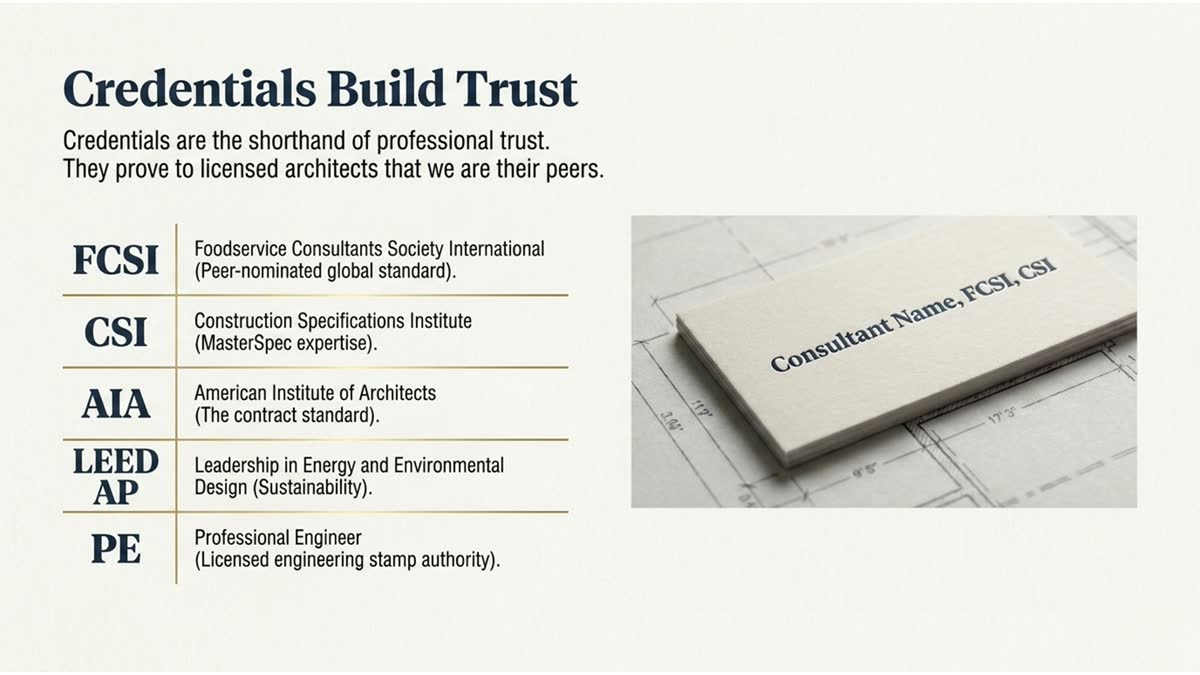
Credentials are the shorthand of professional trust. Knowing what they mean allows you to recognize authority in the room and position Northstar Design Collaborative's team correctly.
Figure B.8 · Key Professional Credentials
| Credential | Full Name | What It Means | Northstar Design Collaborative Connection |
|---|---|---|---|
| FCSI | Professional Services Consultants Society International | Global association for professional consultants. Requires demonstrated expertise and peer nomination. | The firm's principal holds FCSI, CSI credentials. Appears on all proposals. |
| CSI | Construction Specifications Institute | Focused on construction specifications and project delivery standards. | Reinforces expertise in producing MasterSpec documents. |
| AIA | American Institute of Architects | Professional organization for licensed architects. AIA contracts are the industry standard. | Northstar Design Collaborative often works under AIA contract structures. |
| LEED AP | Leadership in Energy and Environmental Design | Expertise in green building design and sustainable construction. | Relevant when projects have LEED certification requirements. |
| PE | Professional Engineer | Licensed engineer with stamp authority on engineering documents. | Northstar Design Collaborative coordinates with PE-stamped MEP engineers. |
▦ Rule of the House
The firm's principal credentials are always listed as: Principal Consultant, FCSI, CSI. In that order, separated by commas. They appear on proposal cover letters, firm biographies, and resume submissions. Never omit the credentials in formal documents.
MODULE B · TERMINOLOGY
B.6 · Business & Sales Terms
Business & Sales Terms
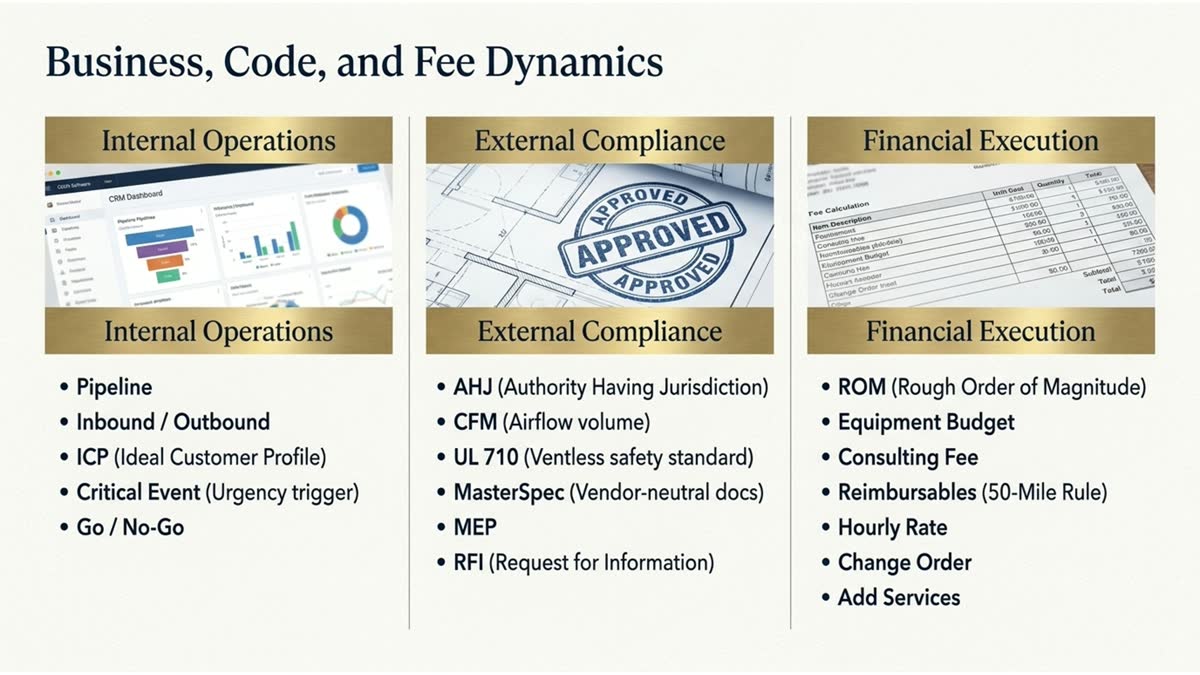
These terms define the commercial language used in Northstar Design Collaborative's sales operations. They appear in CRM records, pipeline discussions, and strategic planning.
Figure B.9 · Business & Sales Terminology
| Term | Definition | Application |
|---|---|---|
| Pipeline / Vantage CRM | The total set of active prospects tracked in Vantage CRM CRM through stages: Pending, Active, Won, Lost. | If it is not in Vantage CRM, it does not exist. Update after every interaction. |
| Inbound / Outbound | Inbound: leads from established relationships. Outbound: leads from new business development and prospecting. | Inbound = technical response. Outbound = empathy + authority signaling + full framework. |
| ICP | Ideal Customer Profile. The type of organization that benefits most from Northstar Design Collaborative's services. | Guides outbound prospecting toward highest win-probability opportunities. |
| Critical Event | The time-sensitive trigger creating urgency: bond deadline, school opening, accreditation inspection. | Identifying the critical event positions Northstar Design Collaborative as the firm that understands urgency. |
| Impact Statement | Concise description of the measurable change the project will produce. Opens the cover letter. | Replaces generic filler with project-specific authority. |
| Go/No-Go | Internal evaluation of whether to pursue an opportunity based on fit, capacity, fee viability, and strategy. | Not every RFP should get a response. Discipline protects team time. |
| ROM | Rough Order of Magnitude. Preliminary cost estimate using sector rates ($300-$350/SF). | Helps clients understand investment scale before design begins. |
| MBE | Certified Minority Business Enterprise. Northstar Design Collaborative's certified status. | Competitive advantage in government and institutional projects. Listed on all proposals. |
MODULE B · TERMINOLOGY
B.7 · Code & Compliance Terminology
Code & Compliance Terminology
Code compliance is not optional. Every Northstar Design Collaborative proposal addresses code requirements. You need these terms to write accurately about what the project requires.
Figure B.10 · Code & Compliance Terms
| Term | Definition | Relevance |
|---|---|---|
| AHJ | Authority Having Jurisdiction. The local official who approves or rejects building plans and equipment installations. | Varies by location. Northstar Design Collaborative designs to the most restrictive standard. |
| CFM | Cubic Feet per Minute. Measurement of airflow volume for sizing exhaust hoods and ventilation. | Underestimating CFM = code violation. Overestimating = wasted money. |
| UL 710 | Underwriters Laboratories safety standard for commercial cooking ventilation equipment. | Ventless equipment must have UL 710 certification to validate the claim. |
| MasterSpec | Specification writing system producing bid-ready procurement documents without referencing specific manufacturers. | Produced during CD phase. Ensures vendor-neutral, competitive bidding. |
| MEP | Mechanical, Electrical, Plumbing. The three engineering disciplines providing building infrastructure. | Every piece of equipment needs specific MEP connections. Coordination happens in DD and CD. |
| RFI | Request for Information. Formal question during construction when a conflict or ambiguity is found. | Reducing RFIs is a measure of design quality. Thorough DD and CD phases minimize them. |
⚠ Watch Out
Northstar Design Collaborative does not provide code compliance certification. The firm designs to code and coordinates with the AHJ, but does not stamp drawings, provide PE certifications, or issue building permits. Never promise code approval in a proposal; promise code-compliant design.
MODULE B · TERMINOLOGY
B.8 · Financial & Fee Terms
Financial & Fee Terms
Fee calculation at Northstar Design Collaborative follows a precise logic. These terms define the financial framework you will use in every proposal.
Figure B.11 · Fee Calculation Logic Flow
1
Step One
Calculate Equipment Budget
Kitchen SF × Sector Rate = Equipment Budget. Example: 2,850 SF × $325 (Hospitality) = $926,250.
2
Step Two
Calculate Consulting Fee
Equipment Budget × Fee % = Consulting Fee. Example: $926,250 × 5% = $46,312. Schools use 4%, all others use 5%.
Figure B.11a · Sector Rates Per Square Foot
$300
Per SF
Schools
K-12 and institutional education. 4% fee rate due to standardized, repeatable layouts.
$325
Per SF
Hospitality
Hotels, restaurants, bars. Standard 5% fee rate.
$350
Per SF
Correctional
Prisons and detention facilities. Highest rate due to security modifications and MEP density.
$200
Per SF
Catering
Warming and catering kitchens. $200-$250/SF. Lower density, reduced code requirements.
Figure B.12 · Financial & Fee Terminology
| Term | Definition | Application |
|---|---|---|
| Equipment Budget | Estimated total equipment cost: Kitchen SF × Sector Rate. | Foundation of fee calculation. Must be accurate. |
| Fee Percentage | Percentage of equipment budget = consulting fee. Standard: 5%. Schools: 4%. | Deviations from standard require Principal Consultant approval. |
| Per Diem | Daily flat rate for on-site services. Northstar standard: $1,600/day. | Applies to CA phase site visits and inspections. |
| Hourly Rates | Project Principal: $200/hr. Project Manager: $170/hr. QC: $125/hr. Revit Operator: $90/hr. | Must be current and match the published schedule. |
| 50-Mile Rule | Projects within 50 miles: no travel paragraph. Beyond 50 miles: travel is reimbursable. | Check project location before including or omitting travel language. |
| COI | Certificate of Insurance. Confirms liability, professional, and workers' comp coverage. | Handled by accounting. Two versions: with and without client named as additional insured. |
MODULE B · APPLICATION
B.9 · Using Language With Clients
How to Use Industry Language With Clients
Knowing the correct terminology is only half the skill. The other half is knowing when to use it, when to translate it, and how to calibrate to the person across the table.
Figure B.13 · Language Calibration by Audience
Architects & Engineers
Full Technical Language
"We will coordinate MEP loads during DD and produce MasterSpec procurement documents in CD."
Precision is respect. They expect the vocabulary.
Facility Directors & Operators
Functional Language
"We will produce detailed equipment plans showing every piece, where it plugs in, and how much power."
Explain what, not what it is called.
Executives & Board Members
Strategic Language
"Our process gives you budget certainty before construction. You review and approve at each step."
Outcomes, budgets, timelines.
✓ Best Practice
Match the room, then elevate. Mirror the client's language level first. If they say "kitchen plans," you say "kitchen plans." Once rapport is established, introduce the precise term naturally: "When we produce the kitchen plans during Conceptual Design, we call that the equipment layout." This teaches the client your language without talking down to them.
❞ The Advocate Principle
"Your job is not to present options and let the client choose. Your job is to have already evaluated every option, identified the correct one for their situation, and walked them toward it with enough context that they arrive at the recommendation with confidence. That is what expertise looks like from the client's side of the table."
Create The Edge Academy · 40 Years in the Room
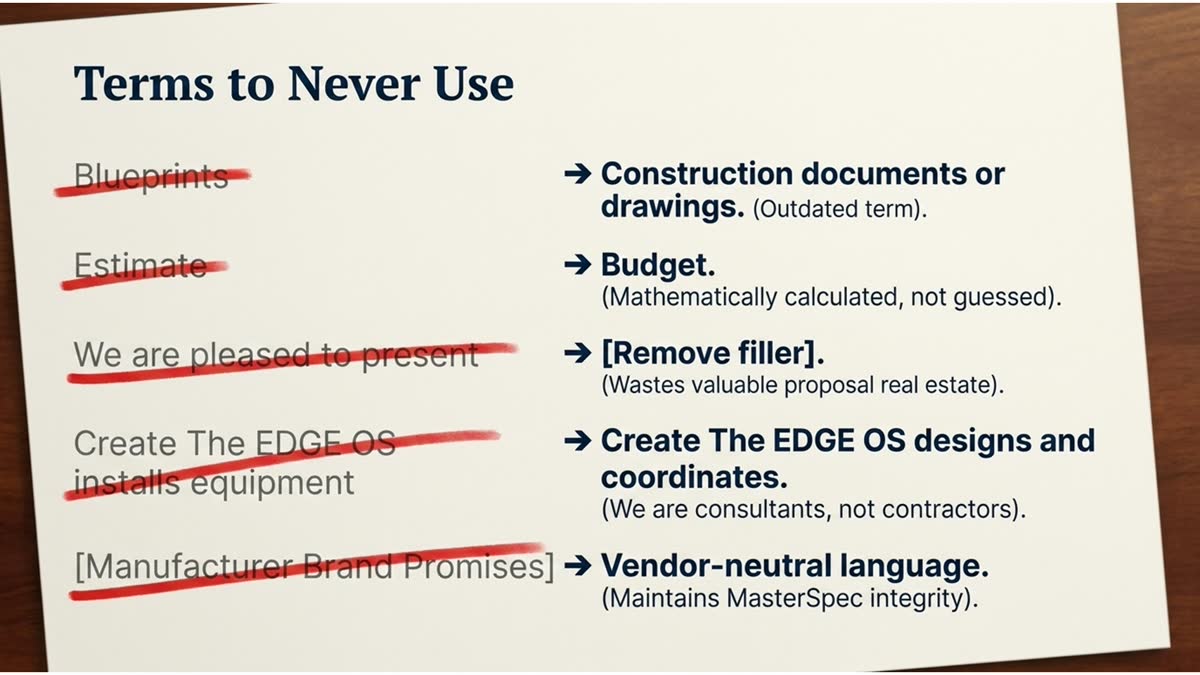
Terms to Never Use in Client Communication
| Forbidden Phrase | Why It Fails | Use Instead |
|---|---|---|
| "We are pleased to present..." | Filler. Wastes the most valuable real estate in the proposal. | Open with the impact statement. |
| "Blueprints" | Outdated. Signals you are not from this world. | "Construction documents" or "drawings" |
| "Estimate" (for budget) | Implies uncertainty. A sector-rate calculation is not an estimate. | "Budget" based on sector rates |
| Manufacturer names in proposals | Northstar Design Collaborative is vendor-neutral. Naming brands violates this standard. | Performance criteria: "10-gallon tilting skillet, electric, floor-mounted" |
MODULE B · ASSESSMENT
✓ Comprehensive Test
Section B Comprehensive Test
15 questions covering Knowledge, Application, and Judgment. One correct answer each. A passing score is 12 correct. Below 10, re-read the sub-modules referenced in the answer legend.
B.1
What does "SD" stand for in the Northstar Design Collaborative design phase structure?
- ASystem Design
- BScope Definition
- CConceptual Design
- DStructural Development
B.2
What is the primary difference between an RFP and an RFQ?
- ARFPs are for government, RFQs are for private sector
- BAn RFP requests a proposal with fees; an RFQ requests qualifications without fees
- CAn RFP is longer than an RFQ
- DRFQs are electronic, RFPs are printed
B.3
What is the sector rate per square foot for a correctional facility kitchen?
- A$350 per square foot
- B$300 per square foot
- C$325 per square foot
- D$250 per square foot
B.4
What does FOG stand for?
- AFloor, Outlet, and Gas
- BFacility Operations Guide
- CFood-grade Operational Grading
- DFat, Oil, and Grease
B.5
What does FCSI represent?
- AFederal Construction Standards Institute
- BProfessional Services Consultants Society International
- CFacility Compliance and Safety International
- DFood and Commercial Services Industry
B.6
A client's RFP uses "30% Design Submittal" and "60% Design Submittal." What should you do?
- AUse only the client's percentage terminology
- BIgnore their terminology and use only standard abbreviations
- CMap their terms to yours: "Phase I: Conceptual Design (referred to as 30% Design Submittal)"
- DAsk the client to clarify before writing
B.7
Project is 30 miles from the Northstar Design Collaborative office. Include a travel reimbursement paragraph?
- ANo, within the 50-mile radius
- BYes, always include travel
- COnly if the client requests it
- DYes, at a reduced rate
B.8
What is the Independence Statement?
- ADeclaration that Northstar Design Collaborative operates without a parent company
- BConfirmation that each office operates separately
- CStatement that the proposal was prepared without help
- DAffirmation that Northstar Design Collaborative does not sell equipment or receive manufacturer commissions
B.9
A superintendent asks about "the kitchen plans." Best response?
- ACorrect them: "We call those construction documents."
- BMirror their language, then introduce the precise term naturally
- CAvoid technical terminology entirely
- DUse full technical jargon: "SD phase Revit equipment plans"
B.10
What is a combi oven?
- AOven combining gas and electric heating
- BDouble-stacked conventional oven
- CVersatile oven combining convection, steam, and combination cooking modes
- DCommercial microwave with convection
B.11
What does AHJ stand for?
- AAuthority Having Jurisdiction
- BArchitectural and Housing Journal
- CApproved Health and Janitorial
- DAmerican Hospitality Jurisdiction
B.12
A proposal says "We will install Brand X combi ovens." What is wrong?
- ACombis are not for hospitality
- BShould specify multiple brands
- CNorthstar Design Collaborative designs, not installs
- DBoth: Northstar Design Collaborative designs (not installs) AND naming a brand violates vendor-neutral language
B.13
Why is the school fee 4% instead of the standard 5%?
- ASchool projects are always smaller
- BStandardized layouts allow more efficient documentation, justifying the reduction
- CSchools have lower equipment costs
- DGovernment caps consulting fees
B.14
Architect sends a document labeled "RFP" but it only asks for resumes and credentials. What do you do?
- ASubmit a full proposal with fees since it says RFP
- BDecline the opportunity
- CRecognize it is an RFQ regardless of label, respond with qualifications, confirm with architect
- DInclude fees as a bonus
B.15
Why does Northstar Design Collaborative use "Professional Services" in some proposals and "Food & Beverage" in others?
- AEach triggers a different Independence Statement: Professional Services for institutional, F&B for hospitality with bars
- BThey are interchangeable
- CF&B is for larger projects
- DProfessional Services is the older term
Answer all 15 questions before submitting.
MODULE B · ASSESSMENT
☑ Answer Legend · Part 1 of 2
Answers · B.1 through B.8
The correct answer is given for each question, followed by the reasoning and the sub-module where the concept was taught. Return to any sub-module that surprised you before moving to the flashcards.
B.1
Correct: C · Conceptual Design
SD = Conceptual Design. First of five AEC phases. Involves layouts, block diagrams, and order-of-magnitude estimates. See B.3.
B.2
Correct: B · RFP requests a proposal with fees; RFQ requests qualifications without fees
RFP = scope + fee. RFQ = qualifications only. Confusing them is a significant professional error. See B.2.
B.3
Correct: A · $350 per square foot
Correctional = $350/SF, the highest rate, due to security modifications and high-density MEP requirements. See B.8.
B.4
Correct: D · Fat, Oil, and Grease
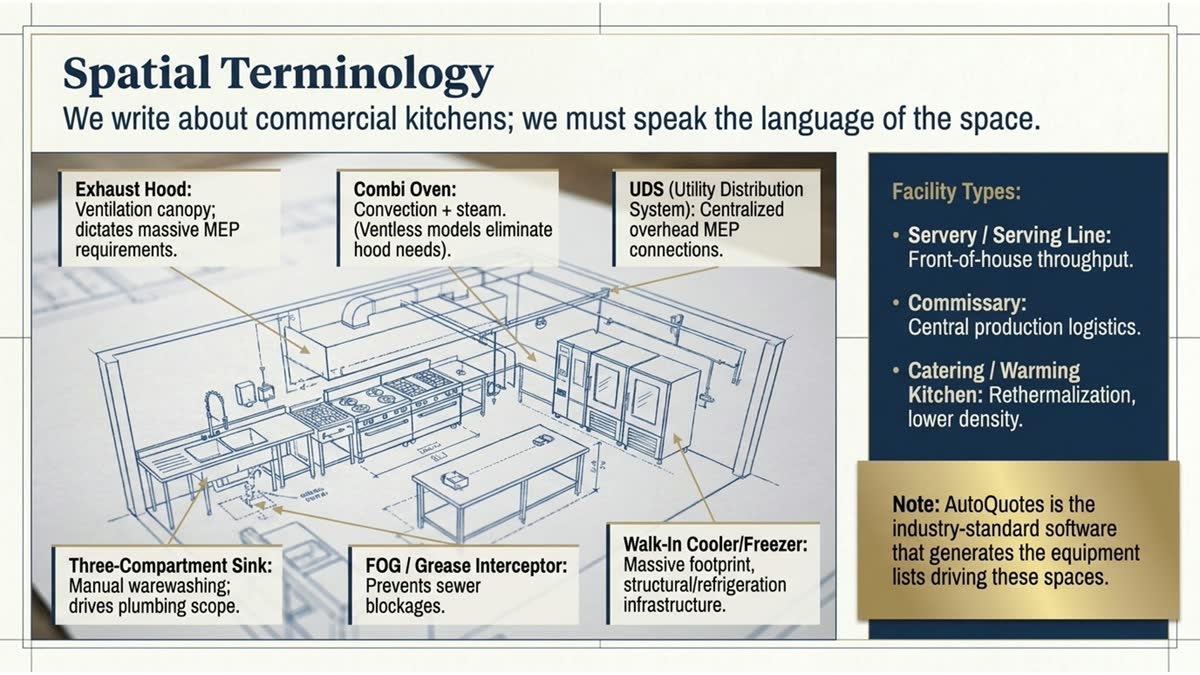
FOG = Fat, Oil, and Grease. Must be captured by grease interceptors before entering municipal sewers. See B.4.
B.5
Correct: B · Professional Services Consultants Society International
FCSI = Professional Services Consultants Society International. The firm's principal holds this credential. See B.5.
B.6
Correct: C · Map their terms to yours
Map client language to Northstar Design Collaborative phases. Shows you read their RFP while maintaining your standards. See B.3.
B.7
Correct: A · No, within the 50-mile radius
The 50-Mile Rule: no travel paragraph for projects within 50 miles. See B.8.
B.8
Correct: D · Affirmation that Northstar Design Collaborative does not sell equipment or receive manufacturer commissions
The Independence Statement affirms vendor-neutral status. Confirm the correct version for your engagement context. Wrong version signals the reviewer you did not read the RFP. See B.2.
MODULE B · ASSESSMENT
☑ Answer Legend · Part 2 of 2
Answers · B.9 through B.15
The remaining answers, with reasoning and sub-module cross-references. Review every question you missed against its source sub-module before moving on to the flashcards.
B.9
Correct: B · Mirror their language, then introduce the precise term naturally
Match the room, then elevate. Build rapport first, then introduce precise terms. See B.9.
B.10
Correct: C · Versatile oven combining convection, steam, and combination cooking modes
Combi = convection + steam + combo. Some models are ventless. Ventless combis eliminate the need for an exhaust hood. See B.4.
B.11
Correct: A · Authority Having Jurisdiction
AHJ = Authority Having Jurisdiction. The local official who approves building plans. Varies by location. See B.7.
B.12
Correct: D · Both errors: Northstar Design Collaborative designs (not installs) AND naming a brand violates vendor-neutral language
Two failures in one sentence. Northstar Design Collaborative designs; dealers and contractors install. And brand names never appear in proposals. See B.7 and B.9.
B.13
Correct: B · Standardized layouts allow more efficient documentation, justifying the reduction
K-12 uses standardized, repeatable layouts enabling efficient documentation. The lower fee reflects efficiency, not lower quality. See B.8.
B.14
Correct: C · Recognize it is an RFQ regardless of label, respond with qualifications, confirm with architect
Read content, not labels. Confirm with the architect. This demonstrates attention to detail and protects against submitting the wrong format. See B.2.
B.15
Correct: A · Each triggers a different Independence Statement
Not interchangeable. "Professional Services" = institutional. "Food & Beverage" = hospitality with bar components. Each requires a different Independence Statement paragraph. Using the wrong one = wrong legal language. See B.2.
MODULE B · STUDY TOOLS
◆ Flashcards · Reference Grid
Fifteen Cards · Front and Back
Fifteen flashcards covering the working vocabulary of Section B. Read the front, recall the back, then check. Use the interactive flip cards for active practice.
1RFP vs. RFQ
RFP = scope + methodology + fee. A decision tool. RFQ = qualifications only, no fee. Never confuse them.
(B.2)
2Five Design Phases
SD (Conceptual Design), DD (Design Development), CD (Construction Docs), BN (Bidding/Negotiation), CA (Construction Admin).
(B.3)
3Independence Statement
Required in every proposal. Confirm the correct version for your engagement context. Wrong version signals the reviewer you did not read the RFP.
(B.2)
4Sector Rates ($/SF)
Schools $300. Hospitality $325. Correctional $350. Catering $200-$250. Fee: 5% (schools: 4%).
(B.8)
5FOG
Fat, Oil, and Grease. Byproducts of commercial cooking captured by grease interceptors before entering municipal sewers.
(B.4)
6AHJ
Authority Having Jurisdiction. The local government official who approves or rejects building plans. Varies by location.
(B.7)
7FCSI
Professional Services Consultants Society International. Global professional association. Credentials listed as: Principal Consultant, FCSI, CSI. Always in that order.
(B.5)
8Combi Oven
Convection + steam + combination cooking in one unit. Some models are ventless, eliminating the need for an exhaust hood.
(B.4)
9The 50-Mile Rule
Within 50 miles: no travel paragraph. Beyond 50 miles: travel is reimbursable. Check project location before writing.
(B.8)
10Vendor-Neutral Language
Never name specific manufacturers in proposals. Specify by performance criteria only. "10-gallon tilting skillet, electric, floor-mounted."
(B.9)
11BIM / Clash Detection
Building Information Modeling: 3D Revit models for coordination. Clash Detection finds conflicts before construction begins.
(B.3)
12MEP
Mechanical, Electrical, Plumbing. Every piece of equipment needs specific MEP connections. Coordination in DD and CD phases.
(B.7)
13Critical Event
Time-sensitive trigger: bond deadline, school opening, accreditation inspection. Identifying it positions Northstar Design Collaborative as urgency-aware.
(B.6)
14AutoQuotes
Industry-standard software for detailed equipment lists and cost estimates. Drives the equipment budget, which drives the fee.
(B.4)
15Professional Services vs. F&B
Not interchangeable. Each triggers a different Independence Statement. Professional Services = institutional. F&B = hospitality with bar components.
(B.9)
MODULE B · STUDY TOOLS
□ Flashcards · Interactive
Tap the Card to See the Answer
Fifteen cards, one at a time. Read the front, attempt the back from memory, then tap to check. Review at Day 1, 3, 7, and 21.
Term · Tap to Reveal
RFP vs. RFQ
RFP = scope + methodology + fee. A decision tool. RFQ = qualifications only, no fee. Never confuse them. (B.2)
Tap card to flip · Use arrows to navigate
1 of 15
MODULE B · STUDY TOOLS
✂ Printable Cut-Out Study Cards
Print, Cut, Carry
Fifteen cards arranged for printing. Cut along the borders. Keep them on your desk. Within thirty days, the terminology will be automatic.
RFP vs. RFQ
RFP = proposal with scope, methodology, and fee. RFQ = qualifications only, no fee quoted. Read the content, not the label.
Five Design Phases
SD (Conceptual Design), DD (Design Development), CD (Construction Docs), BN (Bidding/Negotiation), CA (Construction Admin).
Independence Statement
Required in every proposal. Affirms vendor-neutral status. Confirm the correct version for your engagement context. Wrong version signals the reviewer you did not read the RFP.
Sector Rates ($/SF)
Schools $300 (4% fee). Hospitality $325 (5%). Correctional $350 (5%). Catering $200-$250 (5%).
FOG
Fat, Oil, and Grease. Captured by grease interceptors before entering municipal sewers. Prevents "fatbergs."
AHJ
Authority Having Jurisdiction. Local official who approves building plans. Varies by location. Design to the most restrictive standard.
FCSI
Professional Services Consultants Society International. Credentials listed as: Principal Consultant, FCSI, CSI. Always in that order on formal documents.
Combi Oven
Convection + steam + combination cooking. Some models are ventless, eliminating the need for an exhaust hood.
The 50-Mile Rule
Within 50 miles: no travel paragraph. Beyond 50 miles: travel is reimbursable. Check location before writing.
Vendor-Neutral Language
Never name specific manufacturers. Specify by performance criteria only: "10-gallon tilting skillet, electric, floor-mounted."
BIM / Clash Detection
3D Revit models for design coordination. Clash Detection finds conflicts before construction. Prevents costly field changes.
MEP
Mechanical, Electrical, Plumbing. Every piece of equipment needs specific connections. Coordination in DD and CD phases.
Critical Event
Time-sensitive trigger: bond deadline, school opening, accreditation inspection. Identifies urgency for the client.
AutoQuotes
Industry-standard equipment list and cost estimation software. Drives the equipment budget, which drives the fee.
Professional Services vs. Food & Beverage
Not interchangeable. Each triggers a different Independence Statement. Professional Services = institutional. F&B = hospitality with bar components.