Create The Edge Academy · Proposal Knowledge and Learning System · 2026 Edition
A
Role Overview & Orientation
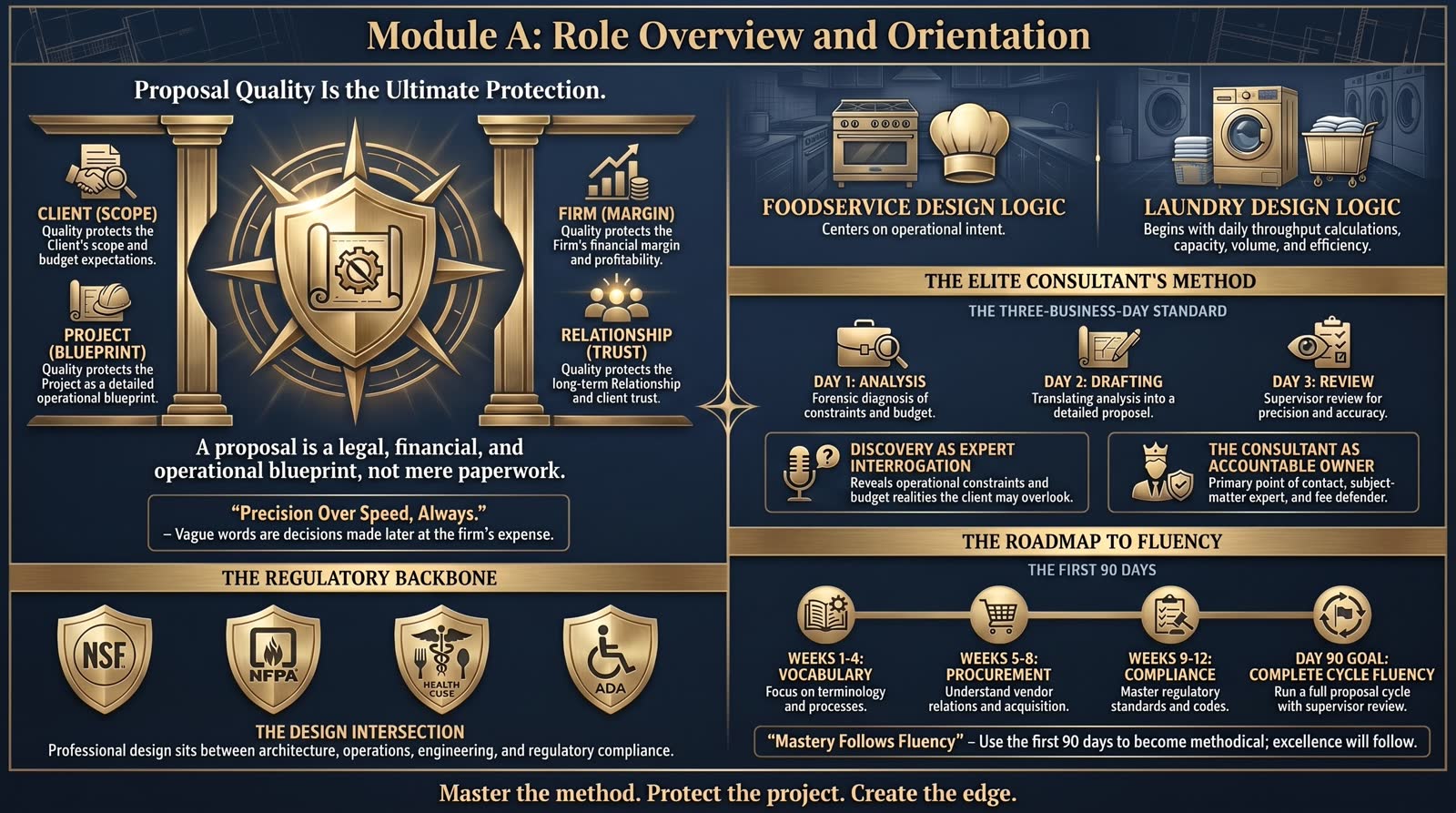
Proposal quality is the ultimate protection. It protects the client, the firm, and the project. This module is the foundation from which every other section draws its logic.
Northstar Design Collaborative · Internal Use Only · 2026
MODULE A · BRIEFINGS
Watch and Listen
Section Briefings
Watch the orientation walkthrough, then listen to the deep dive on the consultant's role and the Northstar standard. Study the module for the full methodology. All three formats cover the same material at different depths.
Video · Role Overview & Orientation
The orientation walkthrough: the firm, the role, the standard, and what separates elite performers.
Audio · The Consultant's Role & The Northstar Standard
The full orientation walkthrough, narrated.
Section A · Infographic
Section A · Concept Mind Map
📊
Mind Map Coming Soon
The Module A concept mind map will be available in a future update.
MODULE A · PRESENTATION
Full Slide Deck
The Precision Mandate
The complete presentation for Module A. Proposal quality is the ultimate protection. These slides walk through the principle, the framework, and the standard.
MODULE A · FOUNDATIONS
A.0 · Overview
The Northstar Standard
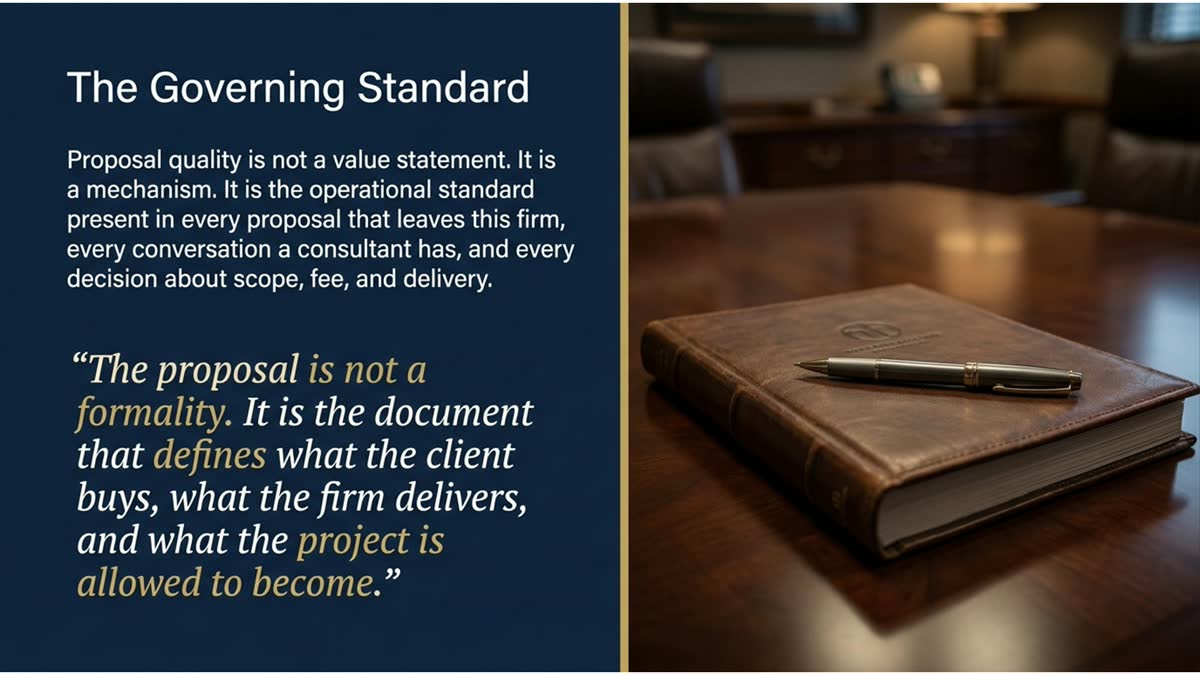
Northstar Design Collaborative holds a single governing principle: proposal quality is the ultimate protection. Not a value statement, not an aspiration. A mechanism.
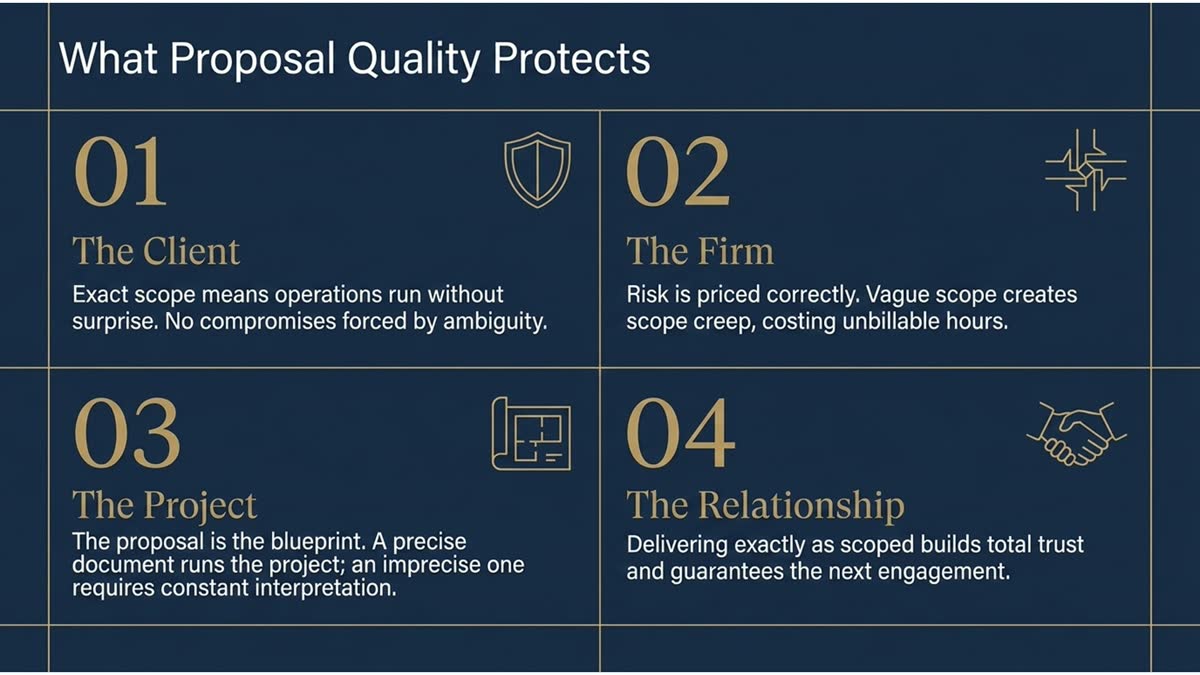
Proposal quality is the ultimate protection. It protects the client by defining exact scope so operations run without surprise. It protects the firm by pricing risk correctly and earning fair margins. It protects the project by creating the blueprint the operations team relies on from day one of construction through years of service.
This training manual is the mechanism that transmits this standard. Not the spirit of it, but the precise, reproducible method. Every module teaches one part of the discipline that produces a Northstar Design Collaborative-quality proposal: the vocabulary, the psychology, the procurement intelligence, the fee arithmetic, the code knowledge, the file discipline. Together they describe what it means to work at the highest level of commercial design consulting.
The standard is not aspirational. It is operational. It exists in every proposal that leaves this firm, in every conversation a consultant has with a client, and in every decision about scope, fee, and delivery. You are reading this because you have joined a firm that holds itself to this standard, and you are expected to hold yourself to it as well.
❞ Expert Insight
"The proposal is still in the room after you leave. Every word in it is working for you or against you. Vague language does not get refined later. It gets interpreted later, by people under pressure, in directions you did not intend. Write with that weight in mind."
Create The Edge Academy · 40 Years in the Room
Figure A.0.1 · What Proposal Quality Protects
1
Protects
The Client
Exact scope means operations run without surprise. The client gets what was designed, not a compromise forced by ambiguity.
2
Protects
The Firm
Risk is priced correctly and margins are earned. Vague scope creates scope creep, which costs the firm hours it cannot bill.
3
Protects
The Project
The proposal is the blueprint the operations team uses. A precise proposal runs the project. An imprecise one requires constant interpretation.
4
Protects
The Relationship
A proposal that performs exactly as written creates trust. The client whose project delivers as scoped calls back with the next one.
▦ Rule of the House
Every proposal that leaves Northstar Design Collaborative is reviewed before it goes. Not because consultants make mistakes, but because a second set of expert eyes is the mechanism that keeps the standard consistent. The review step is not optional and does not come after the deadline.
MODULE A · FOUNDATIONS
A.1 · The Firm
A.1 · Your Company
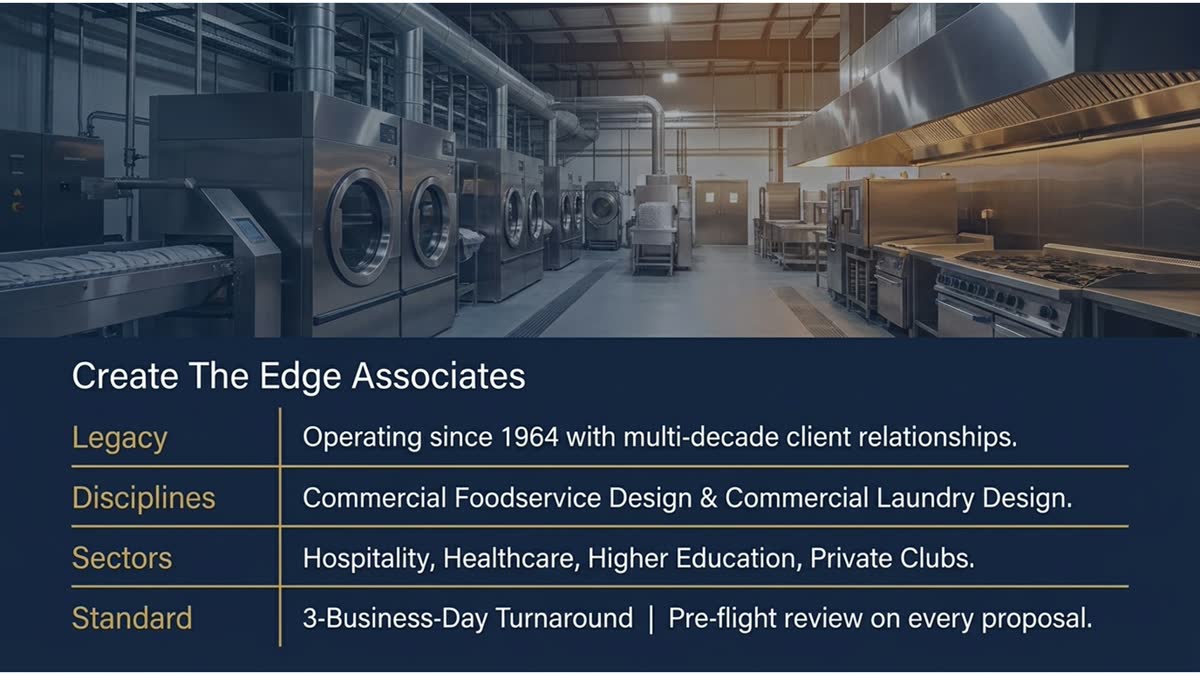
Northstar Design Collaborative operates at the intersection of commercial design, operations, and regulatory compliance. The firm's longevity is not accidental: it is the product of institutional precision applied consistently across decades of engagements.
Northstar Design Collaborative has spent decades building the knowledge base, the client relationships, and the methodological precision that define its reputation in professional consulting.
The firm operates in two primary disciplines: professional consulting services. Professional Services engagements range from a single restaurant in a boutique hotel to a multi-outlet client service operations program across a resort campus. Laundry engagements cover everything from a hospital specialty facility to a high-volume specialty services serving a network of properties. The common thread is complexity: these are environments where the difference between a correctly engineered space and an incorrectly engineered one is measured in years of operational problems and wasted capital.
Northstar Design Collaborative's clients include independent owner-operators, hospitality clients, institutional clients, universities, and private clients across the southeastern US and beyond. What they share is that they have come to Northstar Design Collaborative because they want the problem solved correctly, not approximately.
Figure A.1.1 · The Firm at a Glance
Attribute
Detail
Experience
Decades of professional sales and proposal development
Headquarters
Southeastern United States
Primary Disciplines
Commercial Professional Services Design · Commercial Laundry Design
Applies To
Any professional services firm that writes proposals and sells expertise
Platform
White-label, adaptable to any industry, any firm size, any service line
The Standard
Three-business-day proposal turnaround · Pre-flight review on every proposal · Fee you can defend
☰ From the Files
The firm's client relationships are multi-decade in many cases. A property that hired Northstar Design Collaborative for its original facility design returns for every renovation, expansion, and replacement cycle. Long-term relationships are built on one thing: the firm delivered exactly what it proposed, on scope and on fee.
✓ Best Practice
Know the firm's history well enough to explain it in a two-minute client conversation. Clients who understand they are hiring a firm with more than sixty years of specialized experience in their specific environment type trust the fee and the scope before the proposal is even read.
MODULE A · FOUNDATIONS
A.2 · The Consultant's Role
The Consultant's Role
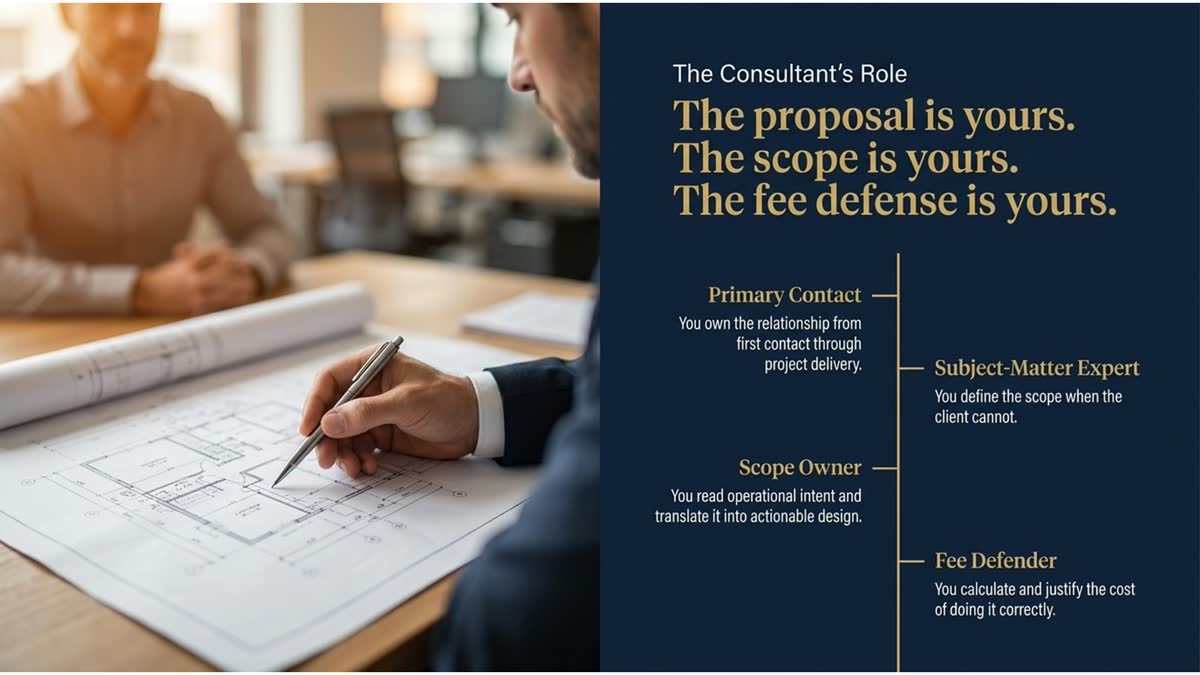
The title is "consultant," but the function is closer to "trusted expert who walks the client from a problem to a solved space." A Northstar Design Collaborative consultant owns the client relationship from first contact through project delivery.
At Northstar Design Collaborative, the consultant is not a support function. The consultant is the primary point of contact, the subject-matter expert in the room, and the person whose name is on the proposal. This is not a role defined by junior hours and senior signatures; it is defined by accountability. The proposal is yours. The scope is yours. The fee defense is yours.
The day-to-day work spans the full arc of an engagement:
Receiving, reading, and analyzing RFPs and RFQs from clients or procurement offices
Client discovery meetings: the forensic process of learning what the client actually needs, covered in detail in Section E
Proposal writing, fee calculation, and scope definition using the methods in Sections G and H
Code and compliance review to ensure the proposed design is permittable and inspectable (Section I)
Coordination with architects, implementation teams, and equipment vendors through delivery
Post-award project management through construction administration
The breadth of this role is what commands the fee. A client who can get a kitchen layout from a restaurant supply company is not looking for a Northstar Design Collaborative consultant. The clients who call Northstar Design Collaborative need someone who can read the operational intent, identify the regulatory constraints, calculate the correct fee for the correct scope, and deliver a design that runs the way the proposal said it would.
❞ Expert Insight
"The consultant who walks into a client meeting unprepared is asking the client to do the consultant's job. Do the research before the room. Know their project type, their decision-making structure, their likely objections. Preparation is not courtesy. It is the first demonstration of professional competence."
Create The Edge Academy · The Proposal Standard
▦ Rule of the House
The consultant does not wait for the client to define the scope. The consultant's expertise exists precisely to define it correctly when the client cannot. A scope defined by the client without expert guidance is a scope that will need to be revised, and revisions after the proposal is signed are costly for everyone.
MODULE A · INDUSTRY CONTEXT
A.3 · The Design Landscape
The Professional Services Landscape
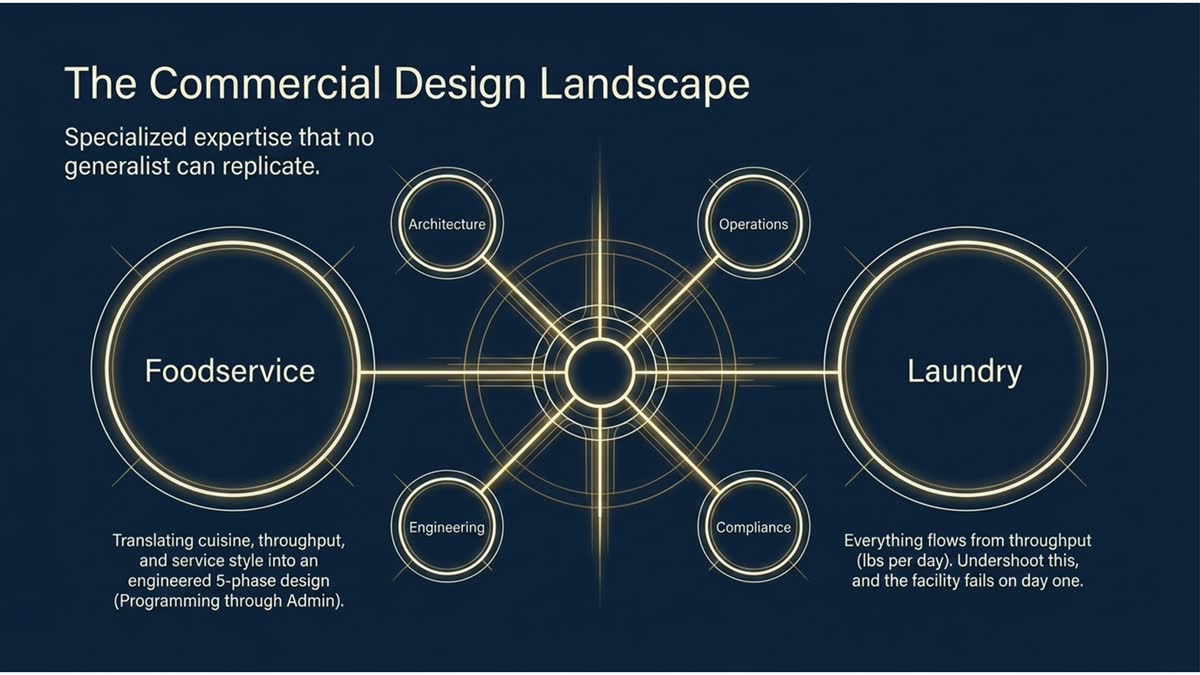
Commercial professional services and specialty design consulting sits at the intersection of architecture, operations, engineering, and regulatory compliance. It is not a field where talented generalists improvise. The clients pay for specialized expertise that no generalist can replicate.
Commercial Professional Services Design
Commercial professional design consulting encompasses the programming, layout, specification, and coordination of professional production operations environments. Restaurants, hotel kitchens, employee cafeterias, hospital operational departments, university client facilitys, private facilitys, service operations: each has its own operational logic, code requirements, and equipment matrix.
A consultant who cannot read the operational intent behind a client brief cannot design for it. A hotel with 400 rooms and three client service operations outlets has different throughput, staffing, and equipment requirements than a 100-seat independent restaurant. The design has to be built around the operation, not the other way around.
Your Secondary Service Line
Commercial specialty design consulting covers the specification and layout of industrial-scale client inventory and textile processing facilities. Hospitals require on-premises specialty service line to meet operational compliance standards. Hotels generate volumes that demand engineered throughput systems. Country clubs and universities run specialized programs with specific fabric requirements and soil types.
The specialty consultant must understand capacity calculation, utility requirements including water, steam, gas, and electrical load, equipment selection, and layout for processing efficiency. A specialty service line specification that underestimates throughput will create a facility that cannot keep up with client inventory demand from the first week of operation.
The Regulatory Backbone
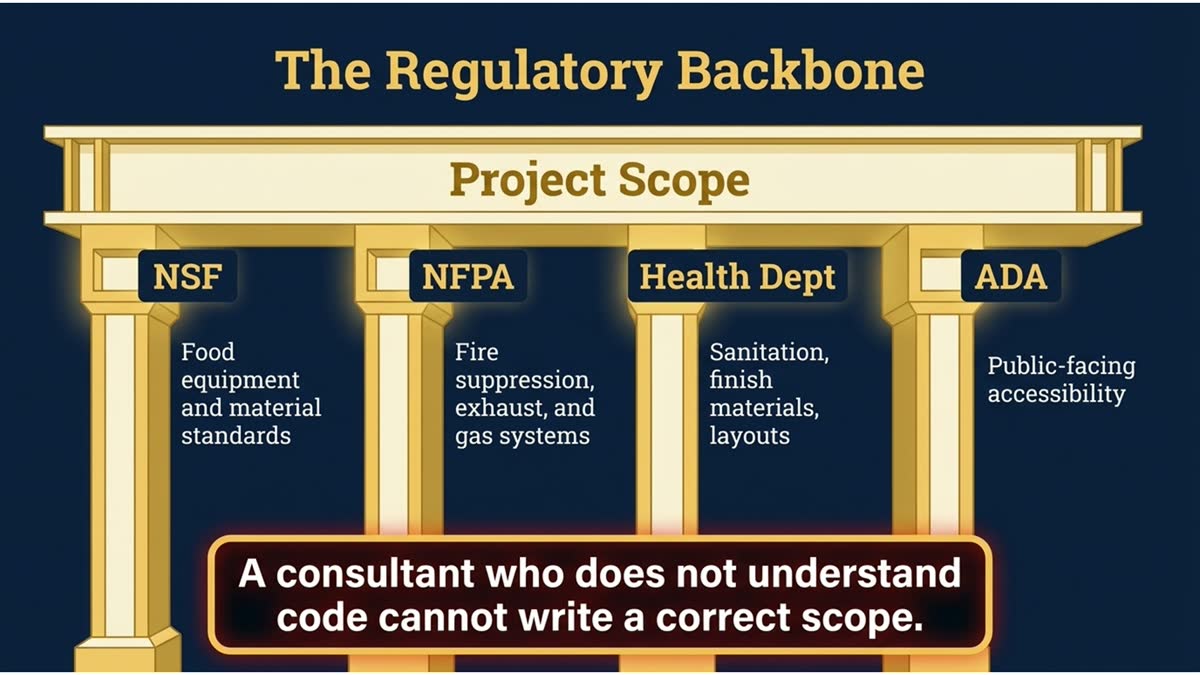
Both disciplines share a common regulatory framework that shapes every design decision before a single piece of equipment is specified. applicable professional standards govern food equipment and material specifications. applicable fire and safety codes govern fire suppression, exhaust, and gas systems. Local regulatory requirements, which vary by jurisdiction, govern sanitation, finish materials, and operational layouts. accessibility compliance requirements apply to any public-facing commercial client service delivery space. Understanding this regulatory environment is not optional; it is the expertise that the fee pays for.
⚠ Critical Knowledge Gap
A consultant who does not know the applicable code for a project cannot write a correct scope. A scope written without code knowledge produces a design that may not be permitted, which means a redesign after the proposal is signed, which is the most expensive mistake a consultant can make.
MODULE A · INDUSTRY CONTEXT
A.4 · How Deals Work
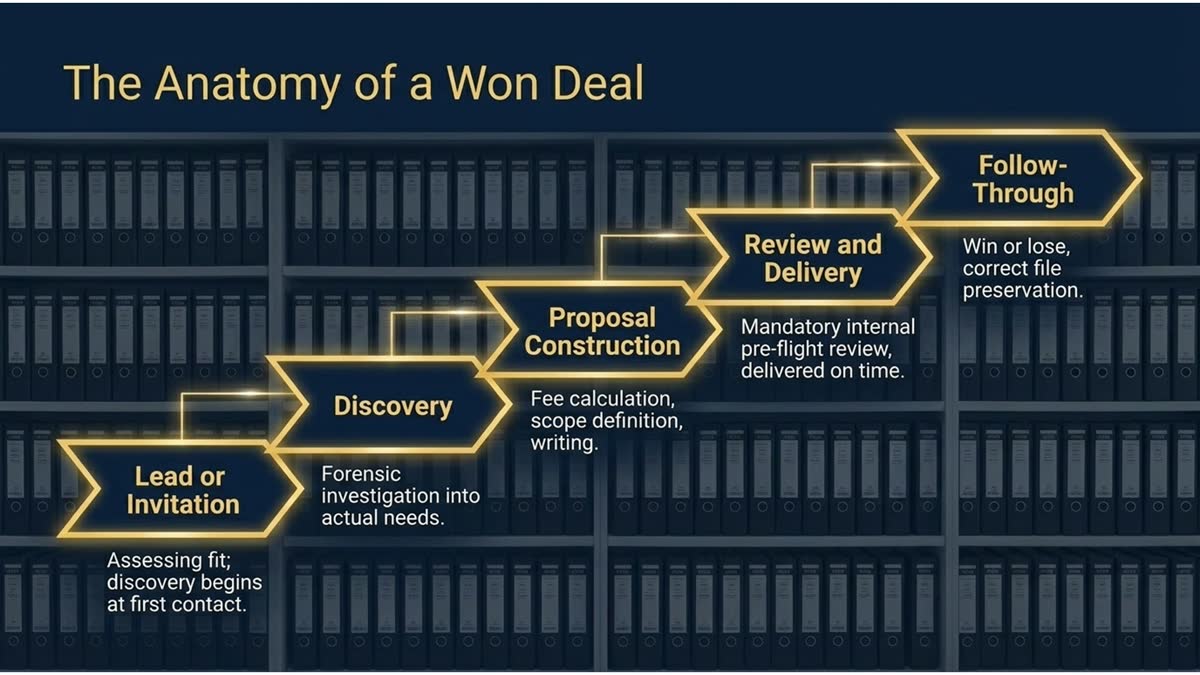
The Anatomy of a Won Deal
A deal does not begin with a proposal. It begins with a relationship, a need, and a conversation. Understanding the arc from first contact to signed contract is what allows a consultant to operate intentionally rather than reactively.
The pipeline from first contact to executed contract is not linear, but it is predictable. Each stage has a defined purpose and a set of deliverables. A consultant who does not understand the full arc cannot manage their position within it.
1
Lead or Invitation
A potential engagement arrives as a direct call from a client or referral source, or as a formal procurement document (RFP or RFQ). The consultant's first task is to assess fit: does this project align with Northstar Design Collaborative's capabilities, and is the client a realistic decision-maker? Discovery begins at first contact, not at the formal discovery meeting.
2
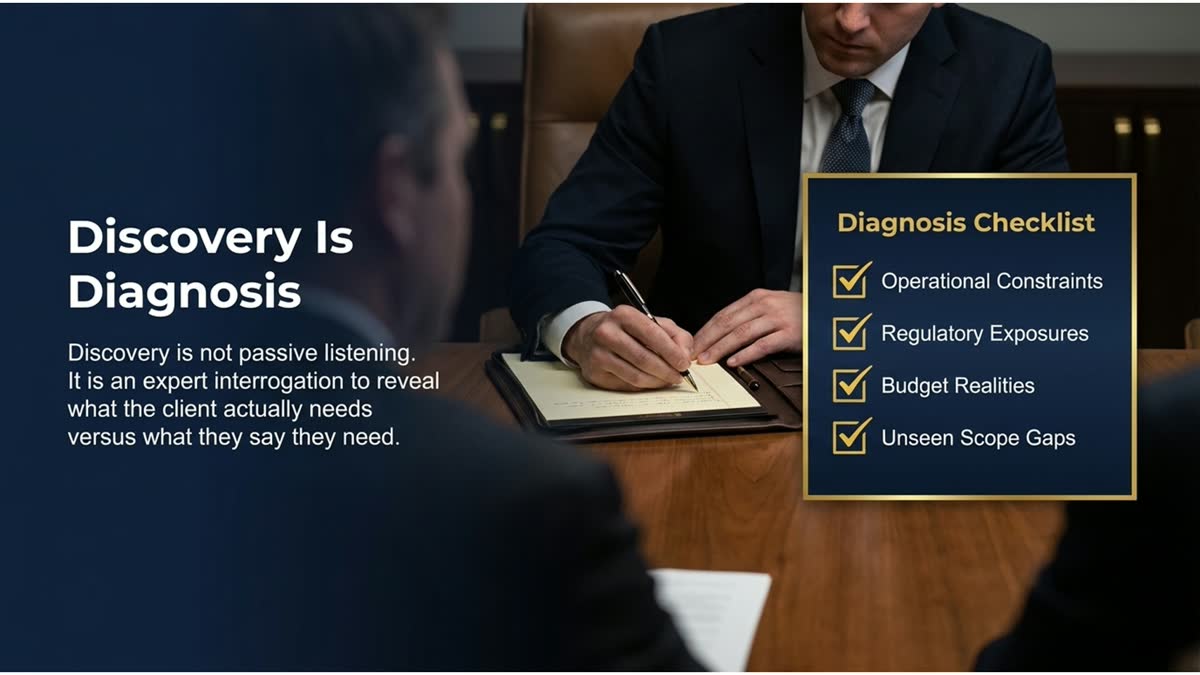
Discovery
The forensic process of learning what the client actually needs, distinct from what they say they need. A discovery meeting is not a listening exercise; it is an expert interrogation. The consultant asks the questions that reveal operational constraints, regulatory exposures, and budget realities the client may not have considered. The full method is in Section E.
3
Proposal Construction
Fee is calculated, scope is defined, and the proposal is written. Sections F, G, H, and K all converge here: the procurement intelligence shapes the response format, the fee method determines the number, the writing standard governs the document, and the filing discipline governs what happens to the file. The proposal that leaves the firm is always reviewed before it goes.
4
Review and Delivery
Every proposal at Northstar Design Collaborative is reviewed before it goes out. The three-business-day standard runs from RFP receipt to delivery. The proposal arrives on time, with correct scope and defensible fees. Arriving on time with a well-crafted proposal is itself a signal to the client about how the project will be managed.
5
Follow-Through
The proposal goes out, questions are answered, and the decision is made. Win or lose, the follow-through is professional and the file is correct. The won deal moves into project delivery with the signed contract filed. The lost deal stays in the precedent library to become the template for the next similar engagement.
✓ Best Practice
Win or lose, file the proposal correctly and note what the client's decision was. The firm's precedent library is built from both outcomes. A lost proposal with correct scope and fee math is valuable next time a similar project arrives. A won proposal filed incorrectly cannot be found when the project comes back for a renovation in five years.
MODULE A · EXCELLENCE
A.5 · The Professional Identity
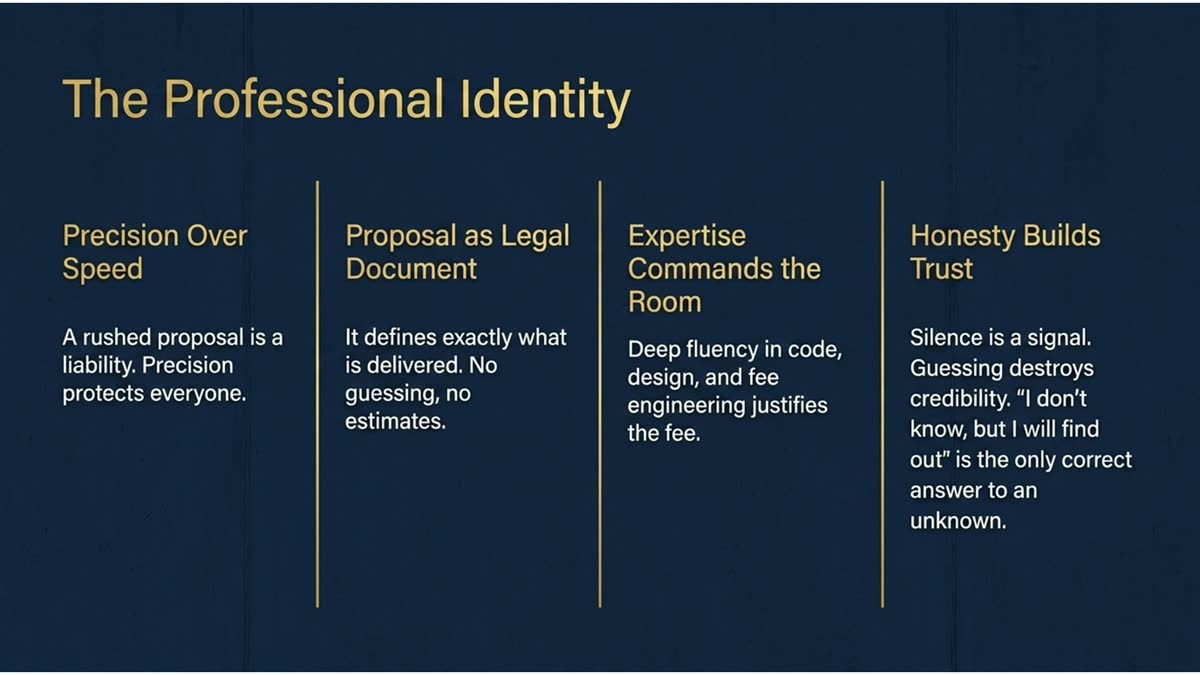
The Professional Identity
Elite commercial design consultants share a set of operating disciplines that distinguish them from practitioners who are technically competent but not yet excellent. These are not personality traits; they are learned and practiced.
Technical competence is the minimum requirement for a Northstar Design Collaborative consultant. The firm's reputation, and the consultant's fee justification, require more than competence. They require the operating disciplines that make competence visible to the client at every interaction.
Precision Over Speed, Always
The three-day turnaround is the standard because it is achievable at the highest quality level. A rushed proposal that ships in one day at lower quality is not an asset; it is a liability. The client who receives a proposal with errors may not say anything at the time, but they remember when the next engagement is being awarded.
The Proposal Is a Legal Document
A Northstar Design Collaborative proposal defines what will be delivered, at what fee, under what scope. It is not a guess or an estimate. Vague proposals create disputes because they leave the definition of "what was promised" open to interpretation. Precise proposals protect everyone: the client, the firm, and the project.
Expertise Commands the Room
A Northstar Design Collaborative consultant who walks into a client meeting must be the most knowledgeable person in the room on the subjects of commercial facility design, specialty design consulting, code compliance, and fee engineering. This is not arrogance; it is the credential that justifies the fee. The client is not hiring a vendor; they are hiring an expert.
Silence Is a Signal
When a client asks a question the consultant does not know the answer to, the correct response is to say so and commit to a response time. The consultant who guesses and gets it wrong loses the relationship. The consultant who admits the knowledge gap and fills it correctly gains one of the most durable forms of client trust: the confidence that comes from demonstrated intellectual honesty.
❞ Expert Insight
"The consultant who guesses under pressure and gets it wrong loses the relationship permanently. The consultant who says 'I do not have that answer yet, but I will have it to you by Thursday' gains something no credential can provide: credibility under uncertainty. Knowing the edge of your knowledge and communicating it cleanly is one of the rarest professional disciplines."
Create The Edge Academy · Sales Intelligence Series
MODULE A · EXCELLENCE
A.6 · Core Service Lines
Your Core Service Lines
Before engaging with any client, every consultant must be able to describe the firm's service lines in terms of client outcomes, not firm activities. The wrong framing of a project, one that starts with what the firm does instead of what the client needs, leads to an incorrect scope. An incorrect scope creates problems that outlast the proposal.
Professional Services Design: The Five-Phase Framework
A professional design consulting engagement typically moves through five phases. The programming phase is where Northstar Design Collaborative learns the operational intent: cuisine type, covers per hour, service style, regulatory environment, and equipment preferences. Everything after programming is translation of that operational intent into engineered space.
Figure A.6.1 · The Five Phases of a Professional Services Design Engagement
Phase
What Happens
Key Deliverable
1. Programming
Operational intent is documented: menu, throughput, service style, code environment
Project program
2. Conceptual Design
Conceptual layouts and equipment categories are developed and presented to the client
Schematic drawings
3. Design Development
Layouts are refined, equipment is specified, utility requirements are defined
Design development drawings
4. Project Documentation
Permit-ready drawings and specifications are produced for the implementation team and sub-contractors
Construction documents
5. Implementation Administration
Submittal documents reviewed, site visits made, punch list completed, operation confirmed
Project closeout
Laundry Design: The Throughput Imperative
Laundry design moves through similar phases, with a heavier emphasis on capacity calculation and utility engineering at the outset. The first question in every specialty service line engagement is throughput: how many pounds of client inventory per day, in what categories (client service operations, primary, secondary, specialty categories), with what turnaround time requirement.
From throughput, all downstream decisions follow: the equipment matrix, utility loads (water, steam, gas, electrical), floor area required, and the staffing model. A specialty design consulting that does not begin with throughput is designed backward, and the consequences appear the first week of full operation when the facility cannot keep pace with client inventory demand.
▦ Rule of the House
Never propose a specialty design consulting without completing a throughput calculation first. A facility sized for 4,000 pounds per day that operates at 6,000 pounds per day is a client crisis in the making, and the proposal that did not calculate throughput correctly is the document that proves the consultant did not do the analysis.
MODULE A · OPERATIONS
A.7 · The Three-Day Standard
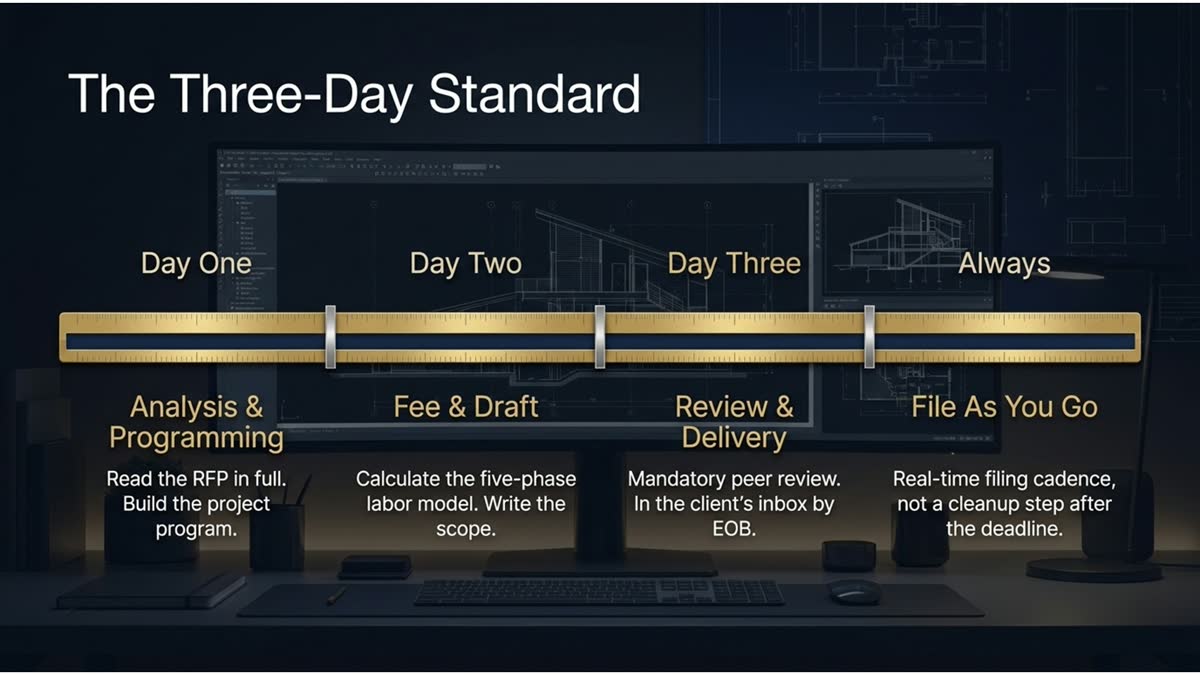
The Three-Day Standard
Northstar Design Collaborative's most operationally defining commitment is the three-business-day turnaround from RFP receipt to a completed proposal in the client's inbox. This is not a stretch goal; it is the standard.
The three-day standard is achievable because the systems in this training manual are in place: the fee calculation methodology is mastered (Section H), the proposal template is precise (Section G), the file discipline is practiced (Section K), and the vocabulary of the field is fluent (Section B). When every part of the method is internalized, three days is enough time to produce a proposal that would take a less-prepared competitor two weeks.
The three-day standard is also a competitive weapon. Most competitors take longer. A client who receives a well-crafted, professionally formatted Northstar Design Collaborative proposal in three days, against competitors who take ten, has already formed an opinion about which firm is organized and capable, before a single fee number is evaluated.
Figure A.7.1 · The Three-Day Window
1
Day One
Analysis and Programming
Read the RFP or RFQ in full. Identify the client type, project scope, service environment, and any code or regulatory signals in the document. Build the project program.
2
Day Two
Fee and Draft
Calculate the fee using the five-phase labor model (Section H). Write the proposal using the Northstar Design Collaborative template (Section G). File every version correctly in the project folder (Section K).
3
Day Three
Review and Delivery
The proposal is reviewed before it goes. The review step is non-negotiable and is completed within Day Three, not after it. The proposal arrives in the client's inbox by end of business.
4
Always
File As You Go
The project folder is named and the file is saved at creation. The sent version is preserved when it goes out. Filing is part of the cadence, not a cleanup step after the deadline.
✓ Best Practice
When an RFP arrives, immediately create the project folder in the shared system using the Year-Month-XX naming convention and save a working file. The three-day clock starts at receipt, and Day One is consumed faster than expected if the first hour is spent deciding where to save the document.
MODULE A · OPERATIONS
A.8 · The First 90 Days
Your First 90 Days
The orientation period is the time to build the foundation. Every module of this training manual teaches one piece of the discipline. The first 90 days is the period in which those pieces are practiced until they are fluent.
The goal of the first 90 days is not mastery in every area. It is fluency in the method and confidence in the vocabulary. A new consultant who cannot yet calculate a fee independently but who knows the five phases, understands the procurement document landscape, and can conduct a competent discovery meeting is on the right trajectory. Mastery follows fluency; fluency does not follow mastery.
Figure A.8.1 · The 90-Day Orientation Roadmap
Weeks 1 and 2: Foundations
Study Section A (this module) and Section B. Understand the firm, the role, and the vocabulary of the field.
Read the full glossary in Section L once as orientation. Return to it when a term is encountered in a client context.
Attend at least one client meeting as an observer. Note vocabulary, the discovery method, and how scope is discussed.
Weeks 3 and 4: Sales and Client Psychology
Study Section C (Sales and Marketing) and Section D (Client Psychology).
Begin participation in discovery calls. Observe how questions are sequenced and how the consultant controls the diagnostic frame.
Study the RFP and RFQ formats in Section F before reading any live procurement documents the firm receives.
Weeks 5 and 6: Discovery and Procurement
Study Section E (Information Gathering and Discovery) in detail. Master the discovery framework before leading a meeting.
Lead one discovery meeting with supervisor present. Debrief the meeting against the discovery framework in Section E.
Review one active or recent RFP using the Section F procurement intelligence framework.
Weeks 7 and 8: Proposal and Fee Engineering
Study Section G (Proposal Writing Mastery) and Section H (Fee Calculation and Pricing).
Build one complete proposal from scratch using the Section G template. Calculate the fee independently using the Section H method. Have both reviewed.
File the practice proposal in the shared system using the Section K naming convention.
Weeks 9 and 10: Code, Compliance, and Strategy
Study Section I (Code, Compliance, and Health Department) and Section J (Meeting Evaluation and SWOT).
Identify the code and regulatory requirements for one project type the firm currently has in its pipeline.
Participate in one SWOT-structured evaluation meeting for a live or upcoming proposal.
Weeks 11 and 12: Systems and Reference
Study Section K (File Naming, Organization, and Systems), Section N (Calculation Tools), and Section M (Reference Section).
Use the Section N calculators on one past or current project. Verify the output against the filed proposal.
By the end of Week 12, be able to run a complete proposal cycle from RFP receipt to delivery, with supervisor review.
Day 90 Checkpoint
Sit down with your supervisor and review one complete proposal from the past 30 days against the Section G checklist.
Identify one area where the proposal would have been stronger if you had applied the training manual method more rigorously.
Commit to a specific practice schedule for the area identified.
❞ Expert Insight
"The first ninety days are not for brilliance. They are for pattern recognition. Learn the method before you try to improve it. The professionals who skip that discipline spend years fixing the assumptions they made in the first month. Methodology is not a constraint on creativity. It is the structure that makes creativity reliable."
Create The Edge Academy · 40 Years in the Room
MODULE A · ASSESSMENT
✓ Comprehensive Test
Twelve Questions on Role, Firm, and the Northstar Standard
Twelve questions across all nine sub-modules. Each has one correct answer. Work through them in one sitting, mark your answers, then check against the answer legend. A passing score is ten correct. Below eight, re-read the sub-modules referenced in the legend.
1
Which of the following best describes the founding principle of Your Company?
ALowest price wins the project
BProposal quality is the ultimate protection for client, firm, and project
CSpeed of delivery is the primary competitive advantage
DClient relationships matter more than proposal precision
2
Northstar Design Collaborative's standard turnaround from RFP receipt to proposal delivery is:
ASame business day
BThree business days
CFive business days
DOne week
3
Northstar Design Collaborative's two primary disciplines are:
AArchitecture and engineering
BResidential design and hospitality consulting
CCommercial professional design consulting and specialty consulting
DCode compliance and project management
4
Proposal quality is described as "the ultimate protection" because it:
AGuarantees the client will sign
BProtects the client, the firm, and the project simultaneously
CReduces the fee needed to win the work
DEliminates the need for a legal contract
5
The first step in the anatomy of a won deal is:
AProposal construction
BDiscovery
CLead or invitation
DReview and delivery
6
In a specialty design consulting engagement, the foundational first question is always:
AThe total equipment budget
BThe preferred vendor list
CThroughput: pounds of client inventory per day by category
DThe color palette and finish materials
7
Northstar Design Collaborative's headquarters is located in:
ACharlotte, NC
BAtlanta, GA
CNashville, TN
DTampa, FL
8
The three-day standard is a competitive advantage because:
AIt reduces the fee by cutting work hours
BIt is required by most RFPs
CMost competitors take longer, so Northstar Design Collaborative signals organizational capability before the fee is even evaluated
DIt allows more revisions before delivery
9
When a client asks a question the consultant cannot answer, the correct response is:
AGuess and move on
BDeflect to a different topic
CAdmit the knowledge gap and commit to a specific response time
DAsk the client what they think the answer is
10
The five phases of a professional design consulting engagement are:
ABid, design, review, approve, deliver
BDiscover, scope, price, propose, close
CDiscovery and Programming, Conceptual Design, Design Development, Documentation, and Implementation Administration
DInterview, draft, review, send, invoice
11
At the 90-day checkpoint, a new consultant should be able to:
ALead all client engagements without supervision
BDesign a complete client facility independently
CRun a complete proposal cycle with supervisor review
DManage construction administration on a live project
12
The regulatory frameworks that shape commercial design decisions include:
ANSF, applicable safety code, applicable regulatory requirements, and ADA requirements
BOSHA, EPA, FDA, and USDA only
COnly the local building code
DNo external codes; design standards are set by the firm
Answer all 12 questions before submitting.
MODULE A · ASSESSMENT
☑ Answer Legend · Part 1 of 2
Answers and Explanations · Questions 1 through 6
The correct answer is given for each question, followed by the reasoning and a cross-reference to the sub-module where the concept was taught. If an explanation surprises you, return to the source sub-module and re-read with the answer in hand.
Question 1
Correct: B · Proposal quality is the ultimate protection
This is the foundational principle of any elite professional services firm. Precision in scope protects the client, the firm, and the project simultaneously. See A.0.
Question 2
Correct: B · Three business days
The three-business-day standard runs from RFP receipt to a completed proposal in the client's inbox. It is achievable because the method is internalized, not because corners are cut. See A.7.
Question 3
Correct: C · Commercial professional design consulting and specialty consulting
Northstar Design Collaborative operates in two primary disciplines. Both sit at the intersection of architecture, operations, engineering, and regulatory compliance. See A.1 and A.6.
Question 4
Correct: B · Protects the client, the firm, and the project simultaneously
Proposal quality protects the client (exact scope prevents operational surprises), the firm (correct risk pricing), and the project (a blueprint the operations team can rely on). See A.0.
Question 5
Correct: C · Lead or invitation
A deal begins with either a direct call or a formal procurement document. Discovery begins at first contact, not at the formal discovery meeting. The consultant's first task is to assess fit. See A.4.
Question 6
Correct: C · Throughput: pounds of client inventory per day by category
All downstream decisions in a specialty service line engagement, including equipment matrix, utility loads, and floor area, follow from throughput. A specialty design consultinged without a throughput calculation is designed backward. See A.6.
MODULE A · ASSESSMENT
☑ Answer Legend · Part 2 of 2
Answers and Explanations · Questions 7 through 12
The remaining answers, with reasoning and sub-module cross-references. Review every question you missed against its source sub-module before moving on to the flashcards.
Question 7
Correct: B · Atlanta, GA
Northstar Design Collaborative is headquartered in Atlanta, GA. State abbreviations (GA, not Georgia) are used throughout Northstar Design Collaborative documents. See A.1.
Question 8
Correct: C · Most competitors take longer, so Northstar Design Collaborative signals organizational capability before the fee is even evaluated
A client who receives a well-crafted Northstar Design Collaborative proposal in three days, when competitors take ten, forms an opinion about firm capability before the numbers are compared. See A.7.
Question 9
Correct: C · Admit the knowledge gap and commit to a specific response time
Intellectual honesty is one of the most durable forms of client trust. A consultant who guesses incorrectly loses the relationship. One who fills the gap correctly, on time, gains it. See A.5.
Question 10
Correct: C · Discovery and Programming, Conceptual Design, Design Development, Documentation, and Implementation Administration
These five phases are the standard arc of a professional design consulting engagement. The fee calculation method in Section H is structured around this same five-phase framework. See A.6.
Question 11
Correct: C · Run a complete proposal cycle with supervisor review
By Day 90, the goal is fluency in the method, not independent mastery. The consultant who can run a complete cycle, with review, is on the right trajectory. Mastery follows fluency. See A.8.
Question 12
Correct: A · NSF, applicable safety code, applicable regulatory requirements, and ADA requirements
These four regulatory frameworks shape every commercial design decision before a single piece of equipment is specified. A consultant who does not know the applicable code cannot write a correct scope. See A.3.
MODULE A · STUDY TOOLS
◆ Flashcards · Reference Grid
Twelve Cards · Front and Back
Twelve flashcards covering the working concepts of Section A. Read the front, recall the back, then check. The interactive flip cards on the next page are for active practice.
1The Northstar Standard
Proposal quality is the ultimate protection. Protects the client (exact scope), the firm (correct risk pricing), and the project (operational blueprint).
(A.0)
2About Your Company
Replace this card with your company's founding story, headquarters location, and primary service lines. This is your brand anchor.
(A.1)
3Commercial Professional Services Design
Programming, layout, specification, and coordination of professional production operations environments. Restaurants, hotels, hospitals, universities, clubs, catering.
(A.3, A.6)
4Commercial Laundry Design
Specification and layout of industrial-scale client inventory processing. Capacity calculation, utility engineering, equipment selection, processing layout. Always starts with throughput.
(A.3, A.6)
5The Three-Day Standard
RFP receipt to completed proposal in the client's inbox in three business days. Day 1: analysis. Day 2: fee and draft. Day 3: review and delivery.
(A.7)
6Anatomy of a Won Deal
Five stages: Lead or invitation, Discovery, Proposal construction, Review and delivery, Follow-through. Win or lose, the file is correct.
(A.4)
7Proposal as Legal Document
A Northstar Design Collaborative proposal defines what will be delivered, at what fee, under what scope. Vague proposals create disputes. Precise proposals protect everyone.
(A.5)
8Five Phases of Professional Services Design
Discovery and Programming, Conceptual Design, Design Development, Documentation, and Implementation Administration. The fee method in Section H is built around these phases.
(A.6)
9Throughput (Laundry)
The foundational first question in specialty design consulting: pounds of client inventory per day, by category. All equipment, utility, and layout decisions follow from throughput.
(A.6)
10The Regulatory Backbone
NSF, applicable safety code, applicable regulatory requirements, and ADA requirements. These shape every design decision before a single piece of equipment is specified.
(A.3)
11The Elite Consultant Disciplines
Precision over speed. Proposal as legal document. Expertise in the room. Intellectual honesty: admit the knowledge gap, fill it correctly, on time.
(A.5)
1290-Day Orientation Goal
Fluency in the method, not mastery. By Day 90: able to run a complete proposal cycle with supervisor review. Mastery follows fluency.
(A.8)
MODULE A · STUDY TOOLS
□ Flashcards · Interactive
Tap the Card to See the Answer
The same twelve cards, one at a time. Read the front, attempt the back from memory, then tap to check.
Term · Tap to Reveal
The Northstar Standard
Proposal quality is the ultimate protection. Protects the client (exact scope), the firm (correct risk pricing), and the project (operational blueprint). (A.0)
Tap card to flip · Use arrows to navigate
1 of 12
MODULE A · STUDY TOOLS
✂ Printable Cut-Out Study Cards
Print, Cut, Carry
Twelve cards arranged for printing. Cut along the borders. Keep them on your desk. Within thirty days, the orientation concepts will be fluent.
The Northstar Standard
Proposal quality is the ultimate protection: protects the client (exact scope), the firm (risk pricing), and the project (operational blueprint).
About Your Company
Add your company founding year, location, and primary disciplines here.
Commercial Professional Services Design
Programming, layout, specification, and coordination of professional production operations environments. Five-phase framework.